Fall & Winter Gardening Checklist
September:
-Fertilize lawns while grass remains green. Grass cannot absorb nutrients during dormancy.
-Similar to grass, fertilize trees, shrubs, and perennials before dormancy.
-This is the final month to plant trees, shrubs, and perennials. Use a root stimulator to help encourage vigorous root growth.
-Prune spring and summer blooming perennials.
-If temperatures are expected to dip below freezing, buy a row cover and protect any tender perennials.
-Plant cool-weather vegetables early in the month. These are all great choices: click me!
-Put preemergent down to control weed seed. If you’re planning to spread grass seed in fall, we DON’T recommend putting preemergent alongside it, as it will kill your new grass seed too. Normally, we recommend spreading preemergent in fall and seeding in spring.
-Keep on top of weeding to limit their spread for next spring.
-Remove spring and summer annuals as they fade. You can replace them with fall annuals like pansies and mums.
-Consider collecting seeds from plants you want to continue growing.
-Many perennials can be divided now, like irises, hostas, peonies, daylilies, rudbeckia, and coneflowers.
-Non-hardy bulbs like dahlias should be pulled out of the garden and overwintered soon.
-Slow watering of roses to harden them off for winter.
October
-Plant fall bulbs early in the month before the ground freezes.
-Clear out all old vegetables and annual plants. If none appear to be diseased, they may be composted. Discard diseased and insect-infested plants in the trash.
-Once vegetable beds are clear, consider spreading straw or animal manure to fertilize beds over winter. You could also plant cover crops like alfalfa, red clover, vetch, and annual rye. Learn more about cover crops here: click me!
-Blow out sprinklers and insulate outdoor faucets and hose bibs. Here are some winterizing sprinkler techniques: click me!
-Rain barrels should be cleaned, disinfected, and disconnected until next spring. Allowing rain barrels to freeze with water still inside damages the plastic.
-Create brush piles of fallen leaves and twigs as winter shelter for beneficial insects and birds. For fire safety, keep them six feet away from flammable structures and buildings.
-Clean and store bird baths if you don’t plan on using them over winter.
-Consider overwintering fountains, as even the largest ones can crack open if they freeze solid. We do sell fountain covers.
-You can attempt to winterize container plants; however, we strongly suggest planting all perennials, trees, and shrubs in the ground. Container plants are less likely to survive, and even with CSU’s directions, we can’t promise they’ll make it. Here’s a guide for winterizing container plants: click me!
-Add mulch to newly planted roses to protect crowns from extreme weather.
November
-Clean up all pumpkin debris as soon as Halloween is over. Leaving it out can make wild animals sick and transfer two fatal diseases among deer and elk: acidosis and chronic wasting disease. It can be composted if mixed well.
-Now is a great time to sharpen and clean garden tools. Here are a few sources on how to do that: How to winterize garden tools: click me! Winterizing lawnmowers: click here!
-Winter water from now till May on days over 50 degrees Fahrenheit, as needed. Use wilfpruf to retain moisture.
-Spread seed for plants that require cold stratification. If our winter is warm again, they can be kept in the fridge.
-If you haven’t yet, add mulch to newly planted roses to protect crowns from extreme weather. Add rose collars to small, weak, or more sensitive rose varieties. Here’s a great video on how to winterize roses: click here!
-Think about when you want paperwhites and amaryllis to bloom and plant accordingly! Depending on the variety, paperwhites take four to six weeks to bloom, and amaryllis six to eight weeks to bloom.
December:
-Winter water on days over 50 degrees Fahrenheit, as needed. Use Wiltpruf to retain moisture.
-Purchase and use Wiltpruf for cut Christmas trees.
-Plan for next year’s garden!
Sources:
Dash, Jan. “Fall And Winter Garden Checklist – Pueblo County Extension.” Colostate.Edu, 2026, https://pueblo.extension.colostate.edu/fall-and-winter-garden-checklist/. Accessed 7 Sept. 2026.
“Fall Gardening – PlantTalk Colorado.” Colostate.Edu, 2026, https://planttalk.colostate.edu/topics/fall-gardening/. Accessed 7 Sept. 2026.
Deer-Proof Your Garden

It’s that dreaded time of year for all gardeners: the annual rut. On top of eating up or trampling your garden, male deer notoriously rub their antlers against any young sapling they can to scrape off their antler velvet. This can be deadly to any tree planted in a garden or yard, especially if the bark is scraped off all around the tree, as it limits nutrient flow through the trunk to the upper branches. The best path to resisting deer is to make your yard as unappetizing as possible, both as a food source, resting place, and scratch spot. There are numerous ways to approach deer prevention, but we’ll split it into two categories: now and later.
Deer Prevention Now
Deer prevention “now” is what you should do at the start of the rut and through its completion. This upkeep begins around September and ends in early December. The most effective way to protect any yard is establishing a fence; one tall enough to prevent jumping is ideal. An 8-foot fence is standard for repelling deer and should be made of woven wire (Swift). You can use T-posts or tree stakes to hold in fencing, and for non-permanent fencing, chicken wire and other temporary garden fencing solutions. We likewise understand not everyone can afford or have a temporary fence in their yard, but building protective fence structures is quite affordable and simple. These structures are called plant plot utilization cages (PPUC for short), and you can learn how to build them here: click me. Install PPUC around newly planted perennials, shrubs, and less hardy trees. Similarly, if you really hate the look of temporary fencing, bark wrap or bark guard can wrap around young tree trunks. Our favourite is plastic bark guard, which is heavy-duty and won’t scrape off easily, unlike paper tree wrap. Likewise, plastic bark guard is ventilated due to its grid-like structure, allowing airflow to interact with the bark and prevent fungal infection.
Another popular temporary solution is applying repellents. These are created from substances deer find distasteful, like clove oil or garlic. Repellents can be spread as a liquid or a solid on or around plants. Repellents need consistent reapplication to be effective; rain and general moisture weaken effectiveness. Scent naturally weakens over time without water, too; reapplication can become a chore.
Deer Prevention Later
Deer prevention “later” means creating efficient, long-lasting practices for deer control. It includes building a permanent fence, planning a “deer-proof” garden, and habitat modification. Creating an anti-deer yard takes years of planning and dedication.
Deer try to avoid human activity, preferring silent meadows and forests. With our city ever expanding, silent spaces for rest can now be found in fence-less backyards, amongst ornamental grasses, on hillsides by roads, etc. Water can be accessed in storm drains, bird baths, ponds, parking lot puddles, creeks, etc. Food can be found in poorly maintained compost, gardens, medians, etc. Eliminate deer’s access to your gardens, ponds, and quiet corners. As mentioned earlier, the best defense against deer is establishing a fence. A permanent fence is perfect, as it requires less annual upkeep than temporary fencing solutions. Permanent fencing is undoubtedly expensive and requires permits and permissions for establishment. The next best solution to deer-proofing your yard or garden is to make it unhabitable to them.
You’re less likely to spot deer by roads or sidewalks unless they wish to cross or are grazing on plants near these locations. You’re also less likely to spot deer where dogs are frequent, like backyards or fenced front yards. Areas where people frequent the garden, whether near sidewalks or outdoor dining areas, are places deer try to avoid. These are ideal locations to plant tender plants that deer enjoy eating, as human presence will protect them (UME). Locations away from human activity should host deer-resistant plants (UME). Habitat modification includes making your yard an open space (if fencing isn’t an option), as deer like hiding spots to rest. Annual pruning and debris removal help tremendously, as you’re making a potential habitat unfamiliar and wide open. Avoid cluttering when designing landscapes and limit plants that grow over two feet tall.
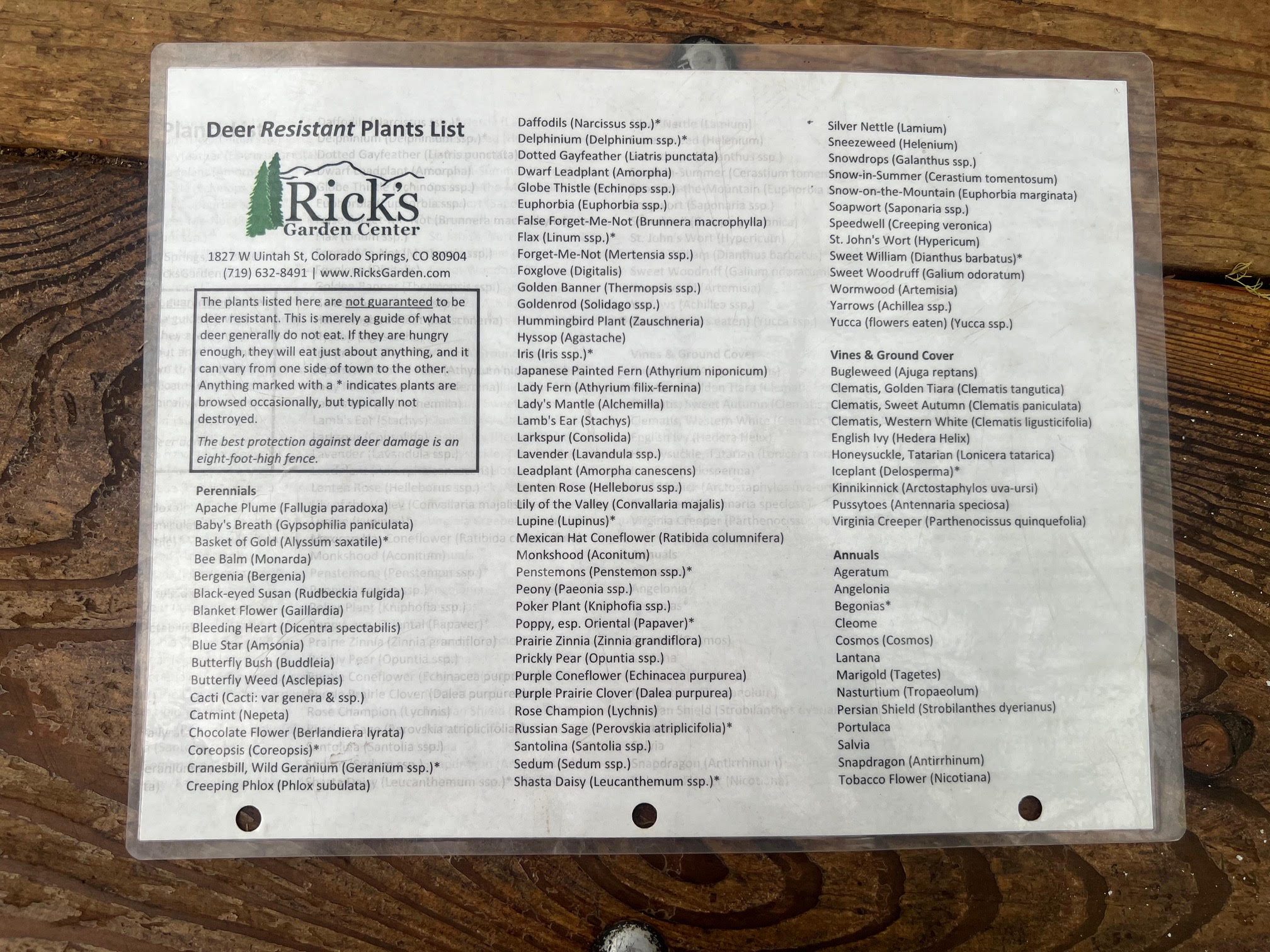
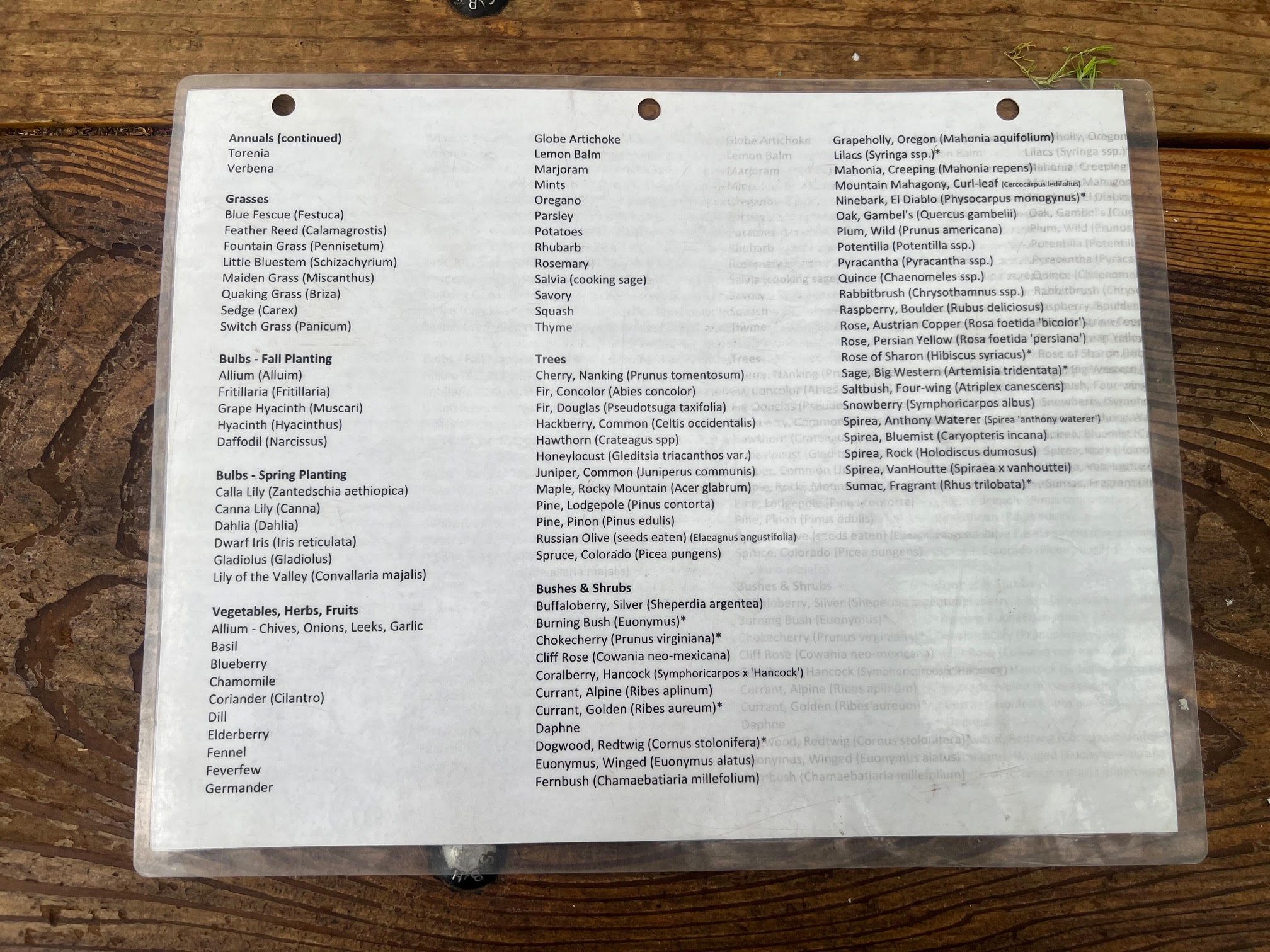
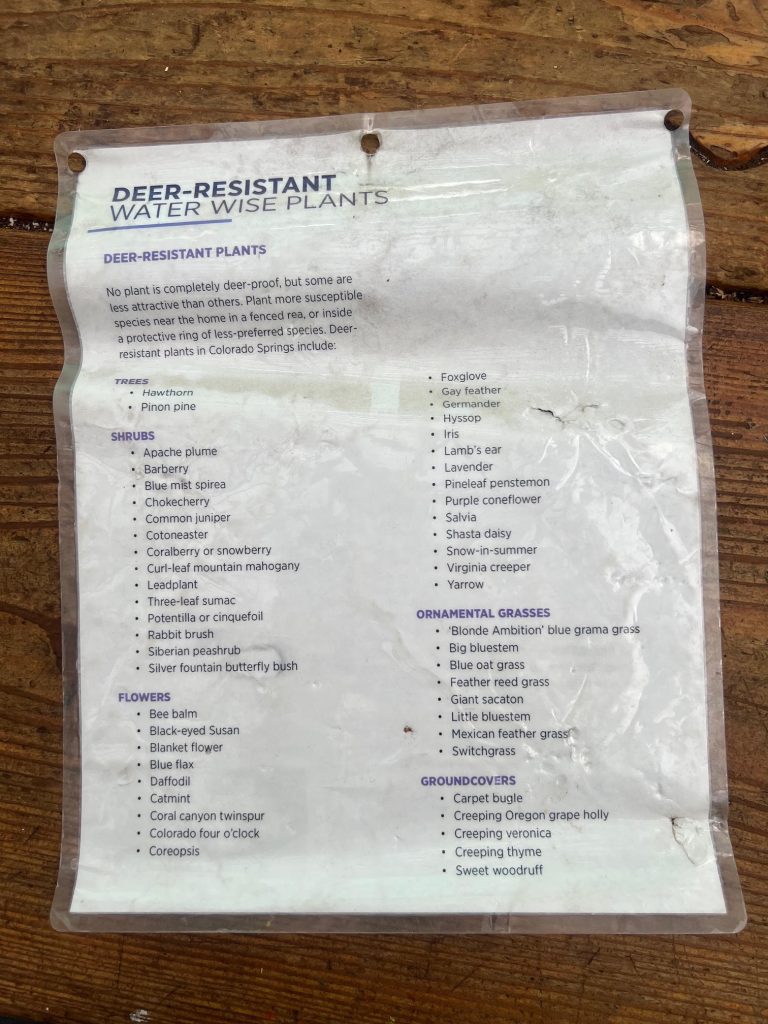
What plants to plant in a deer-proof garden? Sadly, there’s nothing truly deer-proof in the plant world, because if they’re hungry enough, deer will eat any vegetation. But deer typically avoid certain plants. Prickly, extra-fuzzy, and strong-tasting or smelling plants, like alliums, are all top contenders for deer-proof gardens. Poisonous plants also make great alternatives but can be harmful to humans and pets too. Here are a few lists for deer-resistant plants:
Does Deer Hazing Work?
A short-term solution: frightening deer away using loud sounds, animals, and other means can deter them from encroaching on your property. Motion-activated sprinklers, lights, or noisemakers are popular hazing methods; however, over time deer grow used to the sounds and will return to the garden to graze (UME). Dogs can be used as a hazing method, though deer will learn where they can and can’t go. Ultimately, hazing loses its effectiveness no matter what you do.
Distracting Deer With Food: Bad Idea
Some gardeners use food to distract deer from eating their plants. Others leave compost unattended and easily accessible. Regardless of intention, feeding wildlife in Colorado is illegal (CPW). It disrupts the grazing behavior and teaches deer to search human spaces for food, leading to car accidents or learned aggression (CPW). Feeding wildlife can also contribute to spreading two fatal diseases among deer and elk: acidosis and chronic wasting disease (CPW). Those found illegally feeding deer can face a $ 100 fine, which can be reported through Colorado Parks & Wildlife.
Even though deer are our wild neighbors, they can be destructive forces in the garden. There are numerous methods to deter them presently and in the future. Fencing, creating PPUC’s, and using plastic bark guards make great current solutions, while designing deer-proof gardens is a project for next spring. Repellents work generally but require lots of upkeep. Avoid buying hazing devices because deer grow accustomed to their presence. Do your part to report those who feed deer, as that only worsens their presence in human-populated spaces and leads to death by vehicle or disease.
Colorado Parks & Wildlife (CPW). “Feeding Wildlife.” Colorado Parks and Wildlife, 20 Dec. 2023, https://cpw.state.co.us/feeding-wildlifeAccessed 3 Sept. 2026.
Swift, C.E. “Preventing Deer Damage | Colorado State University Extension.” Colorado State University Office of Engagement and Extension, 2 June 2025, https://extension.colostate.edu/resource/preventing-deer-damage/. Accessed 28 Aug. 2026.
University of Minnesota Extension (UME). “How to Manage Deer Damage on Trees and Other Plants.” Umn.Edu, 2026, https://extension.umn.edu/garden-and-home/yard-and-garden/gardening-in-minnesota/white-tailed-deer-damage#habitat-modification-1880563. Accessed 31 Aug. 2026.
Wasp & Yellowjacket Prevention
August is the time when wasp and yellowjacket activity ramps up. These social bugs become more aggressive in August and are more likely to sting. That being said, wasps are important pollinators for gardens. These insects are naturally driven to hunt other bugs, especially caterpillars, and make great organic pest control. Thus, in this article, we’ll present methods that don’t kill these helpful bugs, just deter them instead.
About Wasps & Yellowjackets: Under-Rated Pollinators
Wasps, believe it or not, do contribute to pollinating your garden. Like bees, they perceive the world in ultraviolet and are attracted to blue and purple flowers (Maryland). In certain studies, the Western yellowjacket is a more efficient pollinator than the honey bee (Maryland). Wasps are carnivores yet require sugar and water for fuel, as it’s a high-energy substance (Maryland).
Wasp and yellowjackets’ carnivorous tendencies ramp up in August as they prepare for winter and wish to feed either their larvae protein-rich foods or themselves. Wasps & Yellowjackets live similarly to bees, meaning a dormant queen wakes up in spring and spends much of the summer laying eggs and creating sterile workers (Polistes). Eventually, old queens create new queens, which leave their original nest to establish their own, intensifying the competition between wasps (Polistes).
While established queens use scavenged meat, whether that be roadkill or something from your picnic, to feed their larvae, new queens consume this protein-dense food for themselves in preparation for hibernation. However, all wasps still rely on flower nectar for a quick energy boost. Naturally, these social insects prefer to hunt caterpillars and other insects amongst the garden, and, unfortunately, non-pest insects as well, because wasps are carnivorous generalists (Maryland). With the wonderful and clear weather, you’re likely enjoying meals on a patio or porch. Wasps’ opportunistic feeding nature makes them bold enough to pursue food from your plate. This is obviously annoying and potentially dangerous to those allergic to stings.
Landscaping & Yardkeeping With Wasp In Mind
If you’re building a garden or plan to, create a spot for these social pollinators that avoid human spaces. Blue and purple-colored flowers are always popular with pollinators, yet depending on the wasp, some are likewise attracted to white/yellow, shallow flowers on account of a short proboscis (Maryland). Don’t plant beebalm, penstemon, and other wasp favroites by the doorway, garden gates, or patio. Instead, keep these plants in less-trafficked areas of the garden, like a bright corner, while planting red and pink flowers where people frequent. Limit pesticide use, which may bring unwanted insects into the garden, yet will distract wasps from your plate by providing them with their original prey. Plus, ladybugs, lacewings, and spiders will likewise take care of garden prey and pests too small for wasps.
Similarly, keep access to water and hummingbird feeders away from people-populated areas. Still water is preferred by wasps, so adding a bubbler to a water feature will deter them from frequenting the area. As for hummingbird feeders, cleaning them regularly and keeping them near screened windows is ideal to maintain visibility when observing hummingbirds.
Keep the garden and yard tidy to avoid attracting these insects. Wasps and Yellowjackets are not picky and will even scavenge from the trash can or compost (Green). Similarly, they will scavenge discarded fruit from trees (Green). Prioritize keeping the yard free of fruit debris, cleaning trash cans, and proper composting so the wasps will not be a problem.
Knocking Down Hives
Wasps and Yellowjackets naturally build their nest in hollowed-out trees, on cliffs or sheltered rock faces, and (for yellowjackets) in underground holes (Laucher). Human homes have become a new favorite for these bugs, and wasps often seek gutters, window frames, garages, porches, and more as potential nest locations. Wasps prefer unbothered locations and to be sheltered from the rain. If you notice signs of hive building, such as a small comb being built, we recommend removing this structure with a large stick at night, as wasps have poor night vision (Green). For your safety, we recommend wearing protective clothes (Green). If you happen to own a red-spectrum light, use it, as it will mask your approach, as wasps cannot detect this visual wavelength (Green). You may have to repeat this action to deter them for good. If you don’t wish to get stung or are severely allergic, you can use a wasp spray to take care of the job. Wasp spray will unfortunately kill any larvae within the comb, along with adult wasps. We recommend using that as a final option when none others work.
As for Yellowjackets and their underground nest, there are very few options for controlling them without extermination. The destruction of their nest likewise must be conducted at night for your safety, with ground-nesting insect spray being the best option (Green). Yellowjackets and wasps found within attics, wall voids, or high-up structures should be left to professional care, and beekeepers should be called to handle the situation (Green).
Faux Nest: Do They Work?
You may have heard that a decoy wasp nest will deter others from searching for a new home. Whether made from paper or crocheted, hanging a faux wasp nest implies your yard is “owned” by another colony of wasps or yellowjackets, creating a non-existent territorial rivalry. Sadly, this isn’t true, as different wasps from different colonies have been observed living in proximity (Polistes). While there are no official peer-reviewed studies on decoy nest effectiveness, wasps have been observed in nature establishing hives in close quarters or even inside/on top of an abandoned nest (click here to scroll and see: click me). In fact, wasps may find the decoys to be excellent new homes and build their hives inside them! Thus, we don’t really recommend a faux wasp nest to deter these insects.
Other Friendly Deterrent Methods?
Unfortunately, the internet is filled with nonsense treatments for keeping wasps away. Peppermint oil partially works, but is limited to the certain oils’ effectiveness, as revealed by this study: click here to see: click here). Citronella is also an effective temporary deterrent, primarily in oil or incense form*. Other than that, there isn’t anything particular that will ward away wasps permanently, as these options are temporary solutions.
Wasps, even though they are generalist carnivores, hunt prey insects and pollinate flowers. They are surprisingly more beneficial to gardeners than we think, but at the same time nuisances and potentially dangerous. A combination of gardening and landscaping with wasps in mind and removing hives is the most effective method of keeping these pollinators distracted and away.
*Keep in mind we are on a fire ban. Incense must be kept away from flammable substances and monitored at all times.
Green, J. P. (2020, June 11). Jody Green, PhD. GRO Big Red. https://grobigred.com/2020/06/11/whats-up-with-all-the-wasps/amp/
Laucher, Daniel. “How to Control Yellowjackets without Harming Bees!” (2016, August 2). Fort Collins Nursery. https://fortcollinsnursery.com/fcn-blog/how-to-control-yellowjackets-without-harming-bees/
“Wasps, Surprisingly Cool Pollinators” – Maryland Agronomy News. (n.d.). In blog.umd.edu. Retrieved July 23, 2026, from https://blog.umd.edu/agronomynews/2020/08/31/wasps-surprisingly-cool-pollinators/
Polistes fuscatus. “Do Wasp Nest Decoys Work?” Ask an Entomologist, 15 July 2020, https://askentomologists.com/2020/07/14/do-wasp-nest-decoys-work/. Accessed 31 July 2026.

Growing Onions 101
Our onion, leek, and shallot sets have just arrived, which means it’s soon time to plant them! These flavorful plants are a clear favorite for cooking around the world and are surprisingly easier to grow than most expect. But there’s a first time for everything we understand, so with the recent arrival of these bulb producers, we thought we’d write an easy guide to allium care! So, don’t sweat about day length, fertilization, fungal disease, and soil types; we’ve got you covered!
Onion Day Length Guide Explanation
Figuring out and finding an onion that fits your area’s “day length” standards is initially intimidating. “Day length, that is, the duration of daylight hours within 24 hours, is influenced by the Earth’s tilt. Thus, various amounts of light reach different parts of the Earth throughout the year. Likewise, latitude influences what onions you can and can’t grow. Places with higher latitude (the closer you get to the poles), your day length is extended in summer” (Jameson). This is flipped for places closer to the equator in winter. Certain onions won’t survive beyond the equator, while others won’t survive near the equator, as onions are extremely light-dependent. Now, to keep it simple, our store typically only carries onion varieties suitable for Colorado, which typically has Intermediate-day summer growing periods. You can likewise grow Long-day onions further North in our state. To find out what day-length range your state is, click the link here: Click me!
Planting Time
“Plant onion sets from April to early May (for zone 4) or four to six weeks before your last frost date. If your soil isn’t workable, onion sets can be stored for roughly three weeks in a cool, dark, and well-ventilated space” (Dixondale). DO NOT put them in water.
Perfect Soil
One perk about onions is that they grow well in a variety of soil types! “So long as your soil has excellent drainage, to avoid rot, you can grow onions in sandy or clay-dense soil” (CSU). Just make sure to amend said soils with organic material to generate better aeration (especially for clay soils). We recommend organic materials, such as Cotton bur compost or humus, to help. The onions wouldn’t shy away from nutrient-dense soil! “To amend soil for onion beds, you’ll apply 1 1/2” of green compost or humus over the desired beds, and work said material 8” deep into the soil” (CSU). Likewise, the spot onions will be planted in MUST HAVE good sun (exemplified in the day-length paragraph).
Fertilizing
Start strong with fertilizing your onions by testing your soil. You’ll want a nutrient-rich soil with a balanced NPK ratio with no excess. “Onions require a good dosage of nitrogen; however, too much leads to early maturing and produces poor bulbs. While liquid fertilizers are fine for onions, slow-release solid fertilizers are better, especially if they’re organic. You’ll side-dress onions to fertilize them by scratching in the slow-release fertilizer above ground six inches away from the onion plants. You will want to do this after roots establish and only once or twice per growing season” (UM).
Watering
“Onion roots are shallow and thus sensitive to changes in moisture. Make sure to water frequently, never allowing their soil to dry out. If you allow them to dry during the bulbing stage, bulbs will be small and leathery” (CSU). Our 2025-2026 winter has been dry, and our summer will be too (most likely), so make sure to water your onion sets from now until harvest. An inch of water a week should be perfect, but keep a close eye on them regardless. “Cease watering entirely by August, or when the tops of the plant lie over on the ground. The food made in the leaves will supply the onion with nutrients from this point on” (CSU).
Fungal Issues & Insects
Sadly, it’s not all champagne and caviar with growing onions. “One infamous insect that loves onions are thrips” (CSU). These tiny flying lice-like bugs feed by puncturing leaves and sucking out the sap. They especially love onions, so non-systemic insecticides are essential for keeping them away and exterminating them. Onions also suffer from various fungal issues and diseases, from purple blotch to mildew. Always stick to organic fungicides when protecting onions and never systemics, otherwise you won’t be able to enjoy your crops! If you’re interested in learning more about onion diseases and fungal issues, check out a few articles featured below:
Disease & Fungus: Click me!
Insect Control: Click me!
Soil-Borne Diseases: Click me!
Weeds
Onions are susceptible to weed choking. “Get onion beds free from weeds with organic preemergents (such as corn meal), raking them into the top inch of the soil” (Dixondale). Preemergents will halt weed seed germination for six weeks, but established weeds will remain. Do not use any other herbicide and weed by hand with a hoe, dandelion popper, etc.
That’s just the basics when it comes to growing onions, shallots, and leeks from sets. For further questions, we highly recommend you check out the sources below or the others featured within this article. Feel free to visit the store for help from our staff or email Colorado State Extension Q&A for questions. Don’t let the onions frighten you, happy gardening!
Jameson, Molly. “Understanding Short-Day vs. Long-Day Onions | Panhandle Agriculture.” Ufl.edu, 2024, https://nwdistrict.ifas.ufl.edu/phag/2024/07/26/understanding-short-day-vs-long-day-onions/
“1808 – Growing Onions from Seed – PlantTalk Colorado.” Colostate.edu, 2025, https://planttalk.colostate.edu/topics/vegetables/1808-growing-onions-seed/
“Growing Onions in Home Gardens.” Extension.umn.edu,https://extension.umn.edu/vegetables/growing-onions
“Onion Planting Guide – Dixondale Farms.” Dixondale Farms, 16 Apr. 2020, https://dixondalefarms.com/onion-planting-guide/?srsltid=AfmBOopg3208TqFNnzA7QA7bRfa1G1ElBS05UPDSmU2tczB506uMrrrB
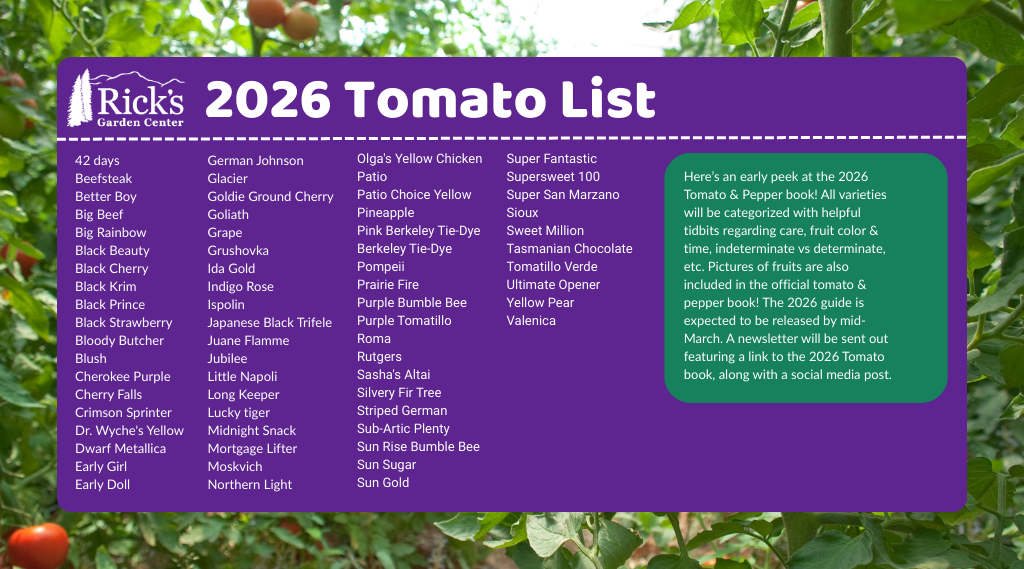
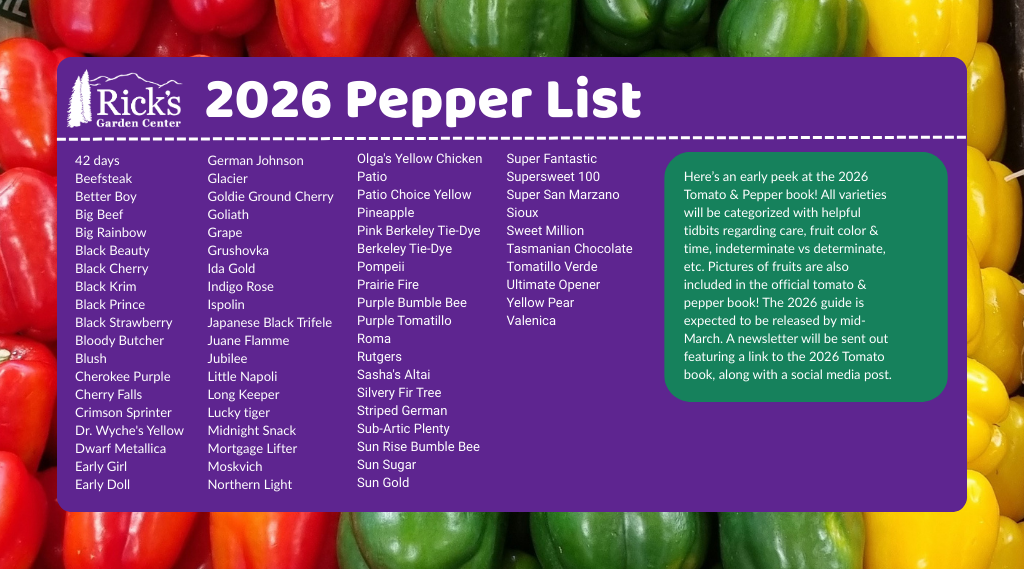
2026 Tomato & Pepper List
Colorado Seed Starting 101: Advice From Rick’s Grow Team
If you want lots of fruits and veggies come summer, the best gardening advice we can offer you is to start early and indoors. Colorado’s growing season is too short for many garden favorites. Eggplants, peppers and tomatoes do not have enough time exclusively outdoors to produce a bountiful harvest. That being said, we’d like to share some of our own techniques for extending the season. Starting seeds inside is the best way to get this jumpstart on the season. And I can thank our spectacular Grow Team, particularly Emma & Jenn, for the helpful advice! If you are a seasoned gardener, or this is your first season growing a garden, enjoy some of our best tips for being successful at seed starting.
Days To Maturity & Pre-Planting
As previously mentioned, Colorado’s growing season is short. When I visited Missouri one time, I was amazed that communities had tomatoes ready to harvest by June, and all of them were grown outside, from seed! Colorado gardeners can have full bushels of tomatoes come June also; we just have to start early and indoors. The best way to plan for this is to research days to maturity for each plant and start according to these specifications. Depending on when the plants reach maturity, you should sow seeds indoors an additional 4 to 6 weeks before the last frost date. For example, peppers need about 85 days to reach maturity. With a bit of math, 85 days turns into 12 weeks. Maturity refers to the number of days it takes the plant to produce fruit. Add four to six weeks on top of that for germination, then research your area’s last frost date through a trusted weather channel. Colorado Springs is typically on May 8th or even Mothers Day. Just to be safe, we’ll use Mother’s Day as a guide for our planning going forward. Subtracting roughly 14 weeks from May 10th means the optimal planting date is January 18th. A little late, but that doesn’t mean you can’t plant peppers; they’ll just fruit a little later! You can find maturity information on the back of seed packets. We’ll also provide a link below this paragraph to one of our favorite references, Colorado State Extension, and their incredible Colorado Vegetable Guide. Click here to read!
Drainage, Drainage, Drainage!
A major seed killer is overwatering, which is easy to do. However, raw seeds need to remain moist until cracking appears, which creates a conundrum in terms of watering. Both Jenn and Emma recommend a combination of fine-draining growing medium and special watering techniques to avoid this. In terms of growing medium, our Grow Team actually starts seeds in vermiculite. It has to be coarse for the best aeration, but if you water less, fine-grade is alright. Seedlings will stay in vermiculite for two weeks, then will be transplanted into a special seed soil or Foxfarm’s Happy Frog soil. Why do we not keep seeds in vermiculite permanently until they can go into larger pots? Vermiculite isn’t great at storing nutrients for seedlings, which obviously isn’t a benefit if you want to grow delicious, healthy, and strong vegetable plants (or any plant). And in terms of watering, we use misters, not watering cans or a hose. Keep the medium moist but not soggy. It’s the Goldilock’s ideal for the seeds!
Warm Bottoms, Cool Tops
A trick to creating a perfect environment for seeds, Emma told me, is to keep the following phrase in mind: warm bottom, cool tops. She and her grow team raise a majority of our vegetable starts in one of our many greenhouses, including a major crop of our tomato varieties. In the greenhouse, we have enough space to use heating mats, and regulate temperature with a greenhouse heater. We also understand many readers aren’t as lucky when it comes to such growing conditions. If you live in an apartment, a small home, or are on a budget, where do you even start, much less keep in mind the mantra “warm bottoms, cool tops?” Let’s translate the quote and make alterations. Seeds should have a warm and inviting substrate to thrive in, preferably one heated by a heating mat. Hence, the “warm bottoms” of the first half of the mantra. Whether growing in a greenhouse or at home, we always recommend a heating mat. It emulates summer growing temperatures that vegetables, like peppers, need. We carry various heat mats, some with timers and others without, that would work perfectly for a smaller grow setting. These mats should be set between 80 to 70 degrees Fahrenheit.
What about the meaning of “cool top?” In our greenhouse, there’s the heater, but even now, the environment is still considered “cool” compared to summer temperatures. The contrast between soil and air tells the seed which direction to grow, establish roots in the warm earth, whilst the stalk should reach to the cool air above ground. The air cannot be too frigid, however (hence the greenhouse heater), or else the sprout will have stunted growth or die. In a home operation, we recommend growing seeds in a warm spot with full sun, using a plastic greenhouse cover only when the sun moves away to keep in the heat. The space you plan to grow seeds in, shouldn’t go below 68 degrees Fahrenheit.
Light On The Subject
This is essential for growing seeds at home, Jenn mentions, “as much light as possible is essential for starting seeds.” And we’re not talking about keeping seeds by windows. We’re talking grow lights, which sounds like overkill to many, but if you want to avoid leggy plants they’re a must. Have you ever grown seeds at home and noticed that as they mature, they become long, stringy, and weak? This is what we mean by leggy. These plants are desperate for light, but without enough, they cease to function since photosynthesis depends on sunlight. Jenn recommends keeping the grow light as close as possible, and eventually “upgrading” seed domes (which is where the grow light can rest upon). This is the best way to avoid leggy seedlings.
Quick but helpful tips (we hope) to Colorado seed starting! We know gardening can be expensive, and some of these supplies will be, but in the end, nothing beats the pride of using your own plant starts for the summer. Plus, your wallet will thank you in the long run, too! Happy gardening!
The Importance of Winter Watering
The Importance of Winter Watering
While your favorite ski resort may be open for business, snowfall in the mountains as well as the front range is down this year. Reports show that snowpack levels across the state are 47% of normal levels. The southern Colorado region has below-average snowpack for this point in the season. While snowfall has been variable and not consistent even as far back as the 1800’s, there are some trends that we need to consider as gardeners. While not very strong, there is a correlation that has become apparent for lower elevation areas in the state (and could be an indicator for us in future years). If the first snowfall is not until November or later, this correlates to a lesser snowfall total for the area as a whole. This concern aligns with recorded temperatures, indicating that our region is experiencing warmer and drier autumns. This is significant for our landscape plants: trees, shrubs, and perennials. To break it down further, without any supplemental water, our outdoor plants are going longer without moisture after the main growing season and receiving potentially less water even when they do finally get snow. Additional food for thought includes that every foot of snow is roughly one inch of rain.
This corresponds to what we hear and see from our customers who come in the spring to replace plants that have experienced “winter kill.” While the term winter kill is traditionally used to describe icy or extremely cold temperatures that cause plant death, customers are using this term to describe plant death in general over the winter season. The type of death these plants are experiencing is completely preventable. They are dying of dehydration. Dry soils do not insulate roots, and thus plants are more susceptible to freeze damage and the swings of freezing/ thawing that we experience in this region.
When we have mild months, like this past November or December, we need to be winter watering. Winter watering requires you to manually water after irrigation or sprinklers are turned off prior to a freeze. Manually watering sounds labor-intensive in our world of automation, but it is rather simple. Remember, dear reader, gardening is one of the last bastions of manual labor. Enjoy the little labor it takes to have beautiful plants! There is a reason the phrase, “labor of love,” exists after all. I digress. Take a garden hose, if you are up for connecting and disconnecting a hose to a spigot, and let the hose trickle at the base of your plant(s) for a little bit. If you have a mature tree, let it trickle for about an hour or two. Less for smaller or less mature plants. If you don’t want to deal with a hose, take a bucket of water and pour it at the base of the plant for a drink. If you want to water your tree properly, you are shooting for ten gallons of water per inch of the tree trunk’s diameter. Which may be even more work than just pulling out your garden hose, that may or may not be mangled under your lawn mower. Pouring buckets of water repeatedly in the same spot may also cause some erosion, so I prefer the slow trickle method. Do this at least once a month on warm days (above 40- 50 degrees Farenheit).
Some individuals look for quick fixes, so they do not have to manually water. I caution against these methods, even if we carry the implements at Rick’s. Tree donuts, water gators, or water bags that have been designed to slowly water trees should only be used during the growing season, and outside of freezing temperatures. If the tree donut freezes at the crown of the tree, this can also cause death. This invention does not mimic snow. Snow slowly melts without creating a solid barrier. A frozen tree donut of ice prevents the tree’s surface roots from “breathing” or completing their nutrient exchange and absorption. Do not look for a shortcut on winter watering.
While many people believe that plants go to sleep during the winter and therefore do not need any care, this is not the case. This would be like a human being in a coma, but never being given an IV. An IV is to ensure that they are receiving liquids and nutrients until they wake back up! Apply this metaphor to your landscape plants. When we do not have the winter moisture and fail to winterwater our landscape plants, they die a perfectly preventable death. Enjoy the sunshine that is common in a Colorado winter, and pull out that garden hose to give your tree a drink!
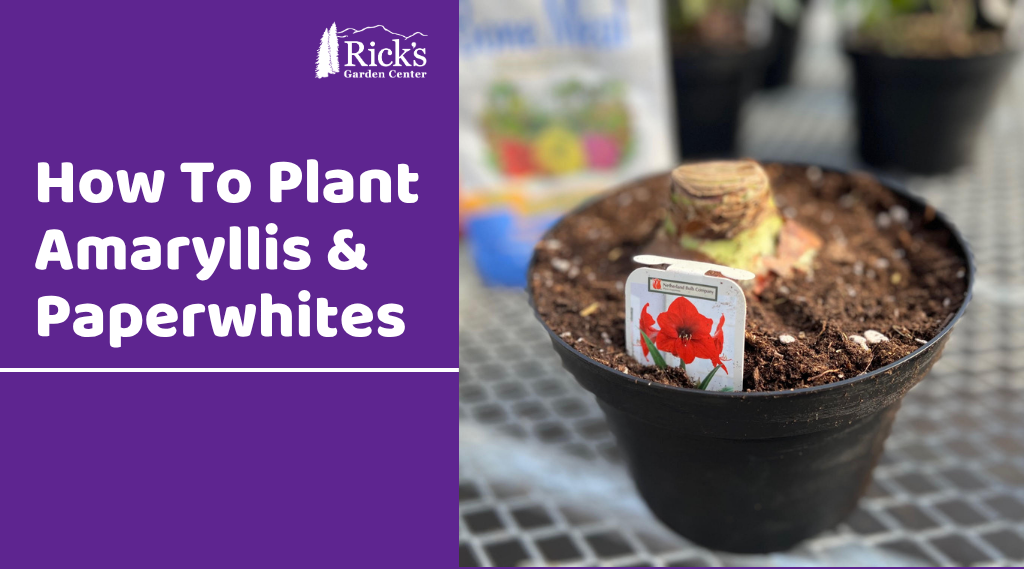
How To Plant Amaryllis & Paperwhites
Our holiday bulbs are here! Make way for Amaryllis & Paperwhites! Because these plants need to be planted about eight to ten weeks in advance, to flower around Christmas, we thought we’d provide this care guide now. Caring for and planting these bulbs is surprisingly easy!
How To Plant Holiday Bulbs
Ingredients:
-Bulbs, one Amaryllis or ten to eight Paperwhites.
-Well-draining soil (we’re using Fertilome Ultimate Potting Soil).
-8 Inch Container.
-Bulb fertilizer (we’re using both blood meal and bone meal).
Step-By-Step Guide
1.) Let’s start with the substrate. To prevent rot, pick soil with excellent drainage for these bulbs. We prefer Fertilome Ultimate Potting Soil, but Fox Farm’s Happy Frog works too. Gardners occasionally plant Amaryllis in a succulent mix, replicating their natural arid environment. Be cautious with this approach because it requires more watering due to extremely well draining soil.
2.) Once your soil is selected, fill about two-thirds of the container of your choice. Here, for both paperwhites and amaryllis, we’re using an 8 inch nursery injection pot. But you can use any kind of container. Having a hole for drainage is essential, and bulbs need some wiggle room.
3.) We advise fertilizing bulbs with a slow-release organic fertilizer. Whilst bulb-specific fertilizer, like Espoma Bulb-Tone, is ideal due to phosphorus levels, a flower fertilizer likewise works. Here, we choose to use blood meal and bone meal, high sources of nitrogen and phosphorus. We’ll eyeball the amounts because with them organic and a slow-release fertilizer burn isn’t a high concern.
4.) Plant your bulbs! Make sure roots are pointing down to the bottom of the pot, tip pointing to the sky. In fact, about one-third of the top of the plant should be above the soil. Amaryllis should have an inch and a half of space around the bulb and enough depth to properly root out. Paperwhites can be planted close together, but bulbs shouldn’t be touching. Think of how an egg carton is arranged! They should also have good depth for their roots to grow.
5.) Now, give the bulbs a light water. This helps pack them in. Rot is the primary cause of death for bulbs, so maintaining a good watering schedule is essential for their survival. We recommend watering every other day in a dry environment, less so in a humid environment. Lower watering to once every four days once green sprouts appear.
2025 Fall Donations: Giving Back to the Local Community
By Katherine Placzek
November is the month where humans best emulate nature-we participate in the magic of giving without the expectation of receiving in return. I hope you all find abundance in your lives, and pass it along to others in small and big ways.
This fall, Rick’s Garden Center donated over $22,000 worth of trees and shrubs to local organizations that benefit the Colorado Springs community. Read on as we highlight their missions. Maybe you can find a way to support their mission or be inspired to find another non-profit group you can volunteer at, or share your monetary gifts. Rick’s vision has always been to help beautify El Paso County and beyond with plants. What is yours?
Mountain Song Community School
An elementary and middle school (grades K through 8), Mountain Song Community School, is a public school that is also a member of the Alliance for Public Waldorf Education. The Waldorf model nurtures the body, mind, and heart of each student. Mountain Song’s curriculum also includes the Agricultural Arts- something Rick’s Garden Center can get behind! Our donation helped further build the berry and native plant portions of their gardens. You can check them out here: Click here!
Flying Pig Farm
Flying Pig Farm is an educational farm located in Manitou Springs. They “… nourish our community and the land we steward by hosting school and community groups and events, facilitating workshops, supporting community gardens, consulting and collaborating with partners, cooking and sharing food, promoting creative expression, holding seasonal festivals, and advocating for healthy relationships with people and the planet.” What a cool mission! They consistently create exciting new community events and educate the local population of all ages about agriculture and self-sustaining techniques. Our donation helped build a “fledgling hedgerow” to offer further privacy and a noise barrier on the farm property. Please check out their programming here: Click here!
TESSA of Colorado Springs
TESSA offers immediate safety for victims of abuse. They have safehouses for women, children, and other victims. They empower and support these individuals while helping them build a safer future. They have several sister programs and are an important part of our community in Colorado Springs. We were able to help re-landscape a portion of their office outdoor space to feel welcoming, but still safe. TESSA provides space for victims to know they are worthy of goodness. This donation will allow them to know they are worthy of beautiful things. Support them in their brave mission: Click here!
Rock Ledge Ranch (in Partnership with the CSU Extension Office)
The Rock Ledge Ranch is a historic ranch, and park at the cusp of the Garden of the Gods Park. They have educational programming while maintaining historic grounds. The CSU Extension is working with them to rehabilitate soil and build a historically authentic greenhouse that will further their educational offerings. We were able to donate native trees/shrubs as well as berry bushes that will help make their grounds feel appropriate to the time, while continuing to support the vision of soil restoration. To support their continued efforts in raising money for the greenhouse construction and to attend their programs, head here: Click here!
Colorado Springs City Horticulture Department and Forestry Department
Our city runs on the funds from the local sales tax. When consumers slow buying, or there is a dip in tourism, like we saw this summer, that revenue becomes strained for our local city departments. Some departments are beginning to see budget cuts or hiring freezes. We were able to help both the Colorado Springs City Horticultural Department and Forestry Department. They both obtained trees/shrubs for beautifying our city and community spaces. Berry bushes and grapevines will be planted in community gardens, and shrubs and trees will find homes in parks, medians, and other public recreation spaces. Check out the City of Colorado Springs website here: Click here!