How To Plant Amaryllis & Paperwhites
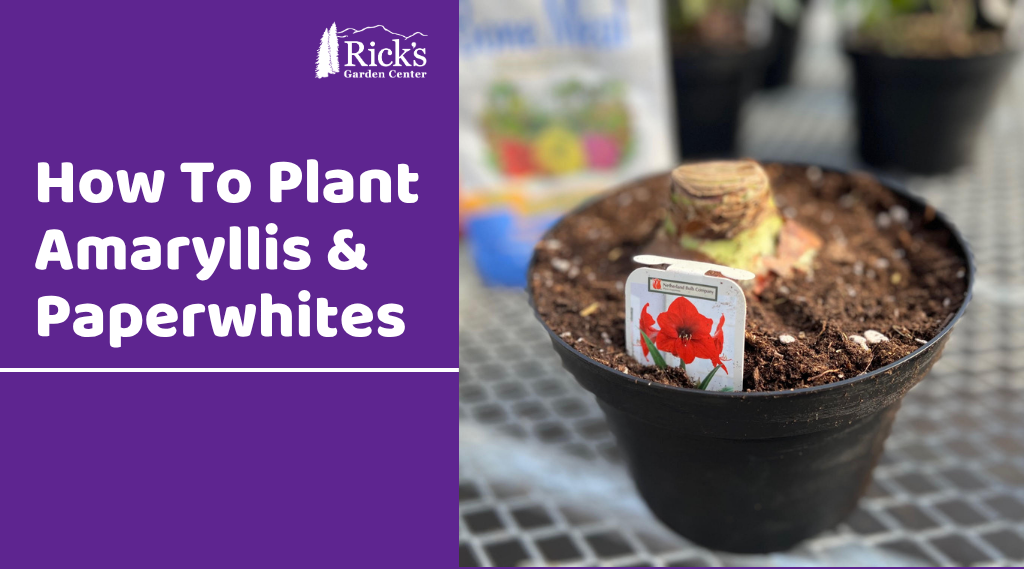
Our holiday bulbs are here! Make way for Amaryllis & Paperwhites! Because these plants need to be planted about eight to ten weeks in advance, to flower around Christmas, we thought we’d provide this care guide now. Caring for and planting these bulbs is surprisingly easy!
How To Plant Holiday Bulbs
Ingredients:
-Bulbs, one Amaryllis or ten to eight Paperwhites.
-Well-draining soil (we’re using Fertilome Ultimate Potting Soil).
-8 Inch Container.
-Bulb fertilizer (we’re using both blood meal and bone meal).
Step-By-Step Guide
1.) Let’s start with the substrate. To prevent rot, pick soil with excellent drainage for these bulbs. We prefer Fertilome Ultimate Potting Soil, but Fox Farm’s Happy Frog works too. Gardners occasionally plant Amaryllis in a succulent mix, replicating their natural arid environment. Be cautious with this approach because it requires more watering due to extremely well draining soil.
2.) Once your soil is selected, fill about two-thirds of the container of your choice. Here, for both paperwhites and amaryllis, we’re using an 8 inch nursery injection pot. But you can use any kind of container. Having a hole for drainage is essential, and bulbs need some wiggle room.
3.) We advise fertilizing bulbs with a slow-release organic fertilizer. Whilst bulb-specific fertilizer, like Espoma Bulb-Tone, is ideal due to phosphorus levels, a flower fertilizer likewise works. Here, we choose to use blood meal and bone meal, high sources of nitrogen and phosphorus. We’ll eyeball the amounts because with them organic and a slow-release fertilizer burn isn’t a high concern.
4.) Plant your bulbs! Make sure roots are pointing down to the bottom of the pot, tip pointing to the sky. In fact, about one-third of the top of the plant should be above the soil. Amaryllis should have an inch and a half of space around the bulb and enough depth to properly root out. Paperwhites can be planted close together, but bulbs shouldn’t be touching. Think of how an egg carton is arranged! They should also have good depth for their roots to grow.
5.) Now, give the bulbs a light water. This helps pack them in. Rot is the primary cause of death for bulbs, so maintaining a good watering schedule is essential for their survival. We recommend watering every other day in a dry environment, less so in a humid environment. Lower watering to once every four days once green sprouts appear.
2025 Fall Donations: Giving Back to the Local Community
By Katherine Placzek
November is the month where humans best emulate nature-we participate in the magic of giving without the expectation of receiving in return. I hope you all find abundance in your lives, and pass it along to others in small and big ways.
This fall, Rick’s Garden Center donated over $22,000 worth of trees and shrubs to local organizations that benefit the Colorado Springs community. Read on as we highlight their missions. Maybe you can find a way to support their mission or be inspired to find another non-profit group you can volunteer at, or share your monetary gifts. Rick’s vision has always been to help beautify El Paso County and beyond with plants. What is yours?
Mountain Song Community School
An elementary and middle school (grades K through 8), Mountain Song Community School, is a public school that is also a member of the Alliance for Public Waldorf Education. The Waldorf model nurtures the body, mind, and heart of each student. Mountain Song’s curriculum also includes the Agricultural Arts- something Rick’s Garden Center can get behind! Our donation helped further build the berry and native plant portions of their gardens. You can check them out here: Click here!
Flying Pig Farm
Flying Pig Farm is an educational farm located in Manitou Springs. They “… nourish our community and the land we steward by hosting school and community groups and events, facilitating workshops, supporting community gardens, consulting and collaborating with partners, cooking and sharing food, promoting creative expression, holding seasonal festivals, and advocating for healthy relationships with people and the planet.” What a cool mission! They consistently create exciting new community events and educate the local population of all ages about agriculture and self-sustaining techniques. Our donation helped build a “fledgling hedgerow” to offer further privacy and a noise barrier on the farm property. Please check out their programming here: Click here!
TESSA of Colorado Springs
TESSA offers immediate safety for victims of abuse. They have safehouses for women, children, and other victims. They empower and support these individuals while helping them build a safer future. They have several sister programs and are an important part of our community in Colorado Springs. We were able to help re-landscape a portion of their office outdoor space to feel welcoming, but still safe. TESSA provides space for victims to know they are worthy of goodness. This donation will allow them to know they are worthy of beautiful things. Support them in their brave mission: Click here!
Rock Ledge Ranch (in Partnership with the CSU Extension Office)
The Rock Ledge Ranch is a historic ranch, and park at the cusp of the Garden of the Gods Park. They have educational programming while maintaining historic grounds. The CSU Extension is working with them to rehabilitate soil and build a historically authentic greenhouse that will further their educational offerings. We were able to donate native trees/shrubs as well as berry bushes that will help make their grounds feel appropriate to the time, while continuing to support the vision of soil restoration. To support their continued efforts in raising money for the greenhouse construction and to attend their programs, head here: Click here!
Colorado Springs City Horticulture Department and Forestry Department
Our city runs on the funds from the local sales tax. When consumers slow buying, or there is a dip in tourism, like we saw this summer, that revenue becomes strained for our local city departments. Some departments are beginning to see budget cuts or hiring freezes. We were able to help both the Colorado Springs City Horticultural Department and Forestry Department. They both obtained trees/shrubs for beautifying our city and community spaces. Berry bushes and grapevines will be planted in community gardens, and shrubs and trees will find homes in parks, medians, and other public recreation spaces. Check out the City of Colorado Springs website here: Click here!

Norfolk Pine
Ah- the Norfolk Pine! The perfect gift for someone who has just moved into their first home around the holidays. The Norfolk Island Pine is also an elegant house plant to welcome into a home for year-round interest!
Also known as Araucaria heterophylla, this plant is not a pine at all. Beautiful and graceful, the Norfolk Pine was originally found on Norfolk Island in the South Pacific, adjacent to Australia. This island is the only natural and known occurrence of the plant. This conifer evergreen tree keeps a symmetrical and compact habit. Due to its branches that present a spiraled and stepped appearance, the tree has a tidy and pyramidal canopy. The needles are fine and almost fern-like, adding a delicate touch. It is so easy to fall in love with this tropical tree! Below you will find care tips for this unique plant.
Moisture:
Norfolk Island Pine’s native habitat is tropical and very humid (50-60%). Our climate is difficult for them, so supply additional humidity through daily misting, a humidifier on a timer, or a humidity tray (set your plant on a tray of water with pebbles). The Norfolk Pine does not like their roots to be waterlogged so make sure you are not over-watering, only watering when the top inch of soil is relatively dry.
Light:
Colorado has very bright light. The Norfolk Pine prefers bright indirect light. Place a Norfolk Pine by a window that receives a good amount of light, but shift the plant away from any direct light, since they are susceptible to sunburn. Many people find that a west or east-facing window is the perfect spot!
Temperature:
Araucaria heterophylla needs a temperature range between 60°F and 70°F. Do not place this tree by a window that transfers cool air inside or a heat vent that could cause scorching or excess drying out of the plant, and its needles. Even slight fluctuations in temperatures can cause stress, so make sure to keep your Norfolk Pine under careful watch. The first sign of stress is needle drop or loss of lower limbs. These lost limbs will not grow back.
Soil:
This beautiful tree would enjoy a well-draining potting mix. The key is moisture retention without becoming waterlogged. Consider a blend of peat moss or finished homemade compost, perlite, and sand. We often also recommend fine-grade orchid bark instead of perlite, since this mimics its native soil.
Fertilizing:
Since Norfolk Island Pines are very susceptible to burning by other means, it should be expected that it’s sensitive to nutrient burn as well. To combat this risk, it is recommended to only fertilize during the growing season (spring and summer, here), and with a diluted half-strength water-soluble fertilizer formulated specifically for house plants. The cadence of fertilizer application is roughly once a month.
Other notables:
The Araucaria heterophylla is sensitive to changes in its environment. Swings in temperature, changes in light intensity, and even moving the plant to different rooms can elicit needle drops. Another thing to note is that this plant is difficult to transplant. We typically recommend delaying transplanting into a larger pot for as long as possible. It is also preferred to up-pot during the growing season. With other houseplants, we usually recommend transplanting into a pot 2 inches larger than the existing pot. For Norfolk Pines, we recommend a pot up to 4 inches larger than its original sized pot. This allows you to reduce the number of up-pots the tree will experience in its lifetime.
While it is hard to keep tropical species like the Norfolk Pine happy in Colorado’s climate, it is well worth it. This tree is festive in the winter months, and a beautiful companion the rest of the year!
Holiday Houseplant Care
So many of us travel around the holidays- sometimes traveling the whole stint of Christmas through the week of New Year’s. This stretch can be long for plants (and you- depending on who you are visiting and how long the trip is), without their regular TLC from you. Our easy-to-follow tips to ensure your plants look amazing after your holiday hiatus.
Moisture
All plants have different moisture needs. Some will need closer attention, and regular watering, even while you are gone. If this is the case for some of your plants, you can implement a self-watering system such as a plant watering globe, plant nanny, or drip irrigation system. A drip irrigation solution is as simple as filling a container of water, and then using a strip of yarn or other water-wicking material immersed in the water to have it “transport” water to the plant in need.
If you prefer, feel free to lean into your community. Ask a neighbor to water while you are gone. Ensure you show them exactly how you water, and how often, so they do not over or under water. Winter air in Colorado is dry. Some of your houseplants will benefit from added humidity. A humidifier on a timer or a DIY humidity tray are great solutions for when you travel. A humidity tray can be as simple as a ceramic drip tray filled with pebbles or clay balls/LECA. Fill the tray with water, and place your potted plant on top of this set-up. Anything that evaporates will immediately be absorbed by the plant.
Mulch
We typically think of mulching as a technique to utilize outdoors, but this technique can also be used indoors! Mulching can help retain moisture during short periods. Use fine-grade orchid bark as a top dress for houseplants that need extra care. Once you have mulched, regularly check that these plants are not retaining too much moisture.
Light
Winter can be a challenge for some houseplants, especially tropical houseplants native to the region around the equator. The equator experiences more consistent sun exposure year-round. You probably have noticed the increased darkness during the winter months in our region. Thus, some of your houseplants may be craving more light right now. Move any plants that need more light to a sunny window, or beneath a grow light on a timer. With temperatures dipping in the winter months, make sure you are aware that the window you place your plant by is transmitting those cold temperatures indoors. No house plant likes a cold draft!
Temperature
As alluded to in the above paragraph, temperature is key to a plant’s happiness! Winter brings new variables for plants. Cooler temperatures translated through windows can cause frost, so move plants that may be susceptible. We also have heaters running in the winter. If you have a plant directly over a vent or radiator, you may see leaf drop or “burnt” leaves. Move any plants that could be affected. Some of these signs will show up only after you have spent time away, so it is helpful to address these risks ahead of time.
Maintenance
While some of us may leave house plant maintenance at the bottom of our to-do list, it is important to address it before you leave for an extended time. Many problems that are riding under the surface can rear their head if left unchecked. This includes any existing pest concerns. Preventative measures can include wiping houseplants down with diluted neem oil and a rag. Neem works as a leaf shine, micro-nutrient, and pest repellant. Other maintenance may include trimming any dead or languishing leaves and stems, so pests cannot get a foothold while you are gone. Trimming in this fashion, also allows plants to conserve energy and focus on being healthy, instead of trying to recuperate in your absence.
Fertilizing
Fertilizing houseplants in the winter is frowned upon since winter is a season of “hibernation” and not growth for houseplants. Winter can be a stressful period for some species due to cold, drier conditions, and reduced light. Fertilizing can present additional stress. Do not fertilize ahead of your travels, where you are not able to observe any drastic changes or your plants’ calls for help!
Now, what if you were unable to follow these recommendations, and you return to a home of sad-looking plants? We will be covering houseplant-rescuing tips next month!