Guide To Hardening Off Tender Plants
Growing Onions 101
Our onion, leek, and shallot sets have just arrived, which means it’s soon time to plant them! These flavorful plants are a clear favorite for cooking around the world and are surprisingly easier to grow than most expect. But there’s a first time for everything we understand, so with the recent arrival of these bulb producers, we thought we’d write an easy guide to allium care! So, don’t sweat about day length, fertilization, fungal disease, and soil types; we’ve got you covered!
Onion Day Length Guide Explanation
Figuring out and finding an onion that fits your area’s “day length” standards is initially intimidating. “Day length, that is, the duration of daylight hours within 24 hours, is influenced by the Earth’s tilt. Thus, various amounts of light reach different parts of the Earth throughout the year. Likewise, latitude influences what onions you can and can’t grow. Places with higher latitude (the closer you get to the poles), your day length is extended in summer” (Jameson). This is flipped for places closer to the equator in winter. Certain onions won’t survive beyond the equator, while others won’t survive near the equator, as onions are extremely light-dependent. Now, to keep it simple, our store typically only carries onion varieties suitable for Colorado, which typically has Intermediate-day summer growing periods. You can likewise grow Long-day onions further North in our state. To find out what day-length range your state is, click the link here: Click me!
Planting Time
“Plant onion sets from April to early May (for zone 4) or four to six weeks before your last frost date. If your soil isn’t workable, onion sets can be stored for roughly three weeks in a cool, dark, and well-ventilated space” (Dixondale). DO NOT put them in water.
Perfect Soil
One perk about onions is that they grow well in a variety of soil types! “So long as your soil has excellent drainage, to avoid rot, you can grow onions in sandy or clay-dense soil” (CSU). Just make sure to amend said soils with organic material to generate better aeration (especially for clay soils). We recommend organic materials, such as Cotton bur compost or humus, to help. The onions wouldn’t shy away from nutrient-dense soil! “To amend soil for onion beds, you’ll apply 1 1/2” of green compost or humus over the desired beds, and work said material 8” deep into the soil” (CSU). Likewise, the spot onions will be planted in MUST HAVE good sun (exemplified in the day-length paragraph).
Fertilizing
Start strong with fertilizing your onions by testing your soil. You’ll want a nutrient-rich soil with a balanced NPK ratio with no excess. “Onions require a good dosage of nitrogen; however, too much leads to early maturing and produces poor bulbs. While liquid fertilizers are fine for onions, slow-release solid fertilizers are better, especially if they’re organic. You’ll side-dress onions to fertilize them by scratching in the slow-release fertilizer above ground six inches away from the onion plants. You will want to do this after roots establish and only once or twice per growing season” (UM).
Watering
“Onion roots are shallow and thus sensitive to changes in moisture. Make sure to water frequently, never allowing their soil to dry out. If you allow them to dry during the bulbing stage, bulbs will be small and leathery” (CSU). Our 2025-2026 winter has been dry, and our summer will be too (most likely), so make sure to water your onion sets from now until harvest. An inch of water a week should be perfect, but keep a close eye on them regardless. “Cease watering entirely by August, or when the tops of the plant lie over on the ground. The food made in the leaves will supply the onion with nutrients from this point on” (CSU).
Fungal Issues & Insects
Sadly, it’s not all champagne and caviar with growing onions. “One infamous insect that loves onions are thrips” (CSU). These tiny flying lice-like bugs feed by puncturing leaves and sucking out the sap. They especially love onions, so non-systemic insecticides are essential for keeping them away and exterminating them. Onions also suffer from various fungal issues and diseases, from purple blotch to mildew. Always stick to organic fungicides when protecting onions and never systemics, otherwise you won’t be able to enjoy your crops! If you’re interested in learning more about onion diseases and fungal issues, check out a few articles featured below:
Disease & Fungus: Click me!
Insect Control: Click me!
Soil-Borne Diseases: Click me!
Weeds
Onions are susceptible to weed choking. “Get onion beds free from weeds with organic preemergents (such as corn meal), raking them into the top inch of the soil” (Dixondale). Preemergents will halt weed seed germination for six weeks, but established weeds will remain. Do not use any other herbicide and weed by hand with a hoe, dandelion popper, etc.
That’s just the basics when it comes to growing onions, shallots, and leeks from sets. For further questions, we highly recommend you check out the sources below or the others featured within this article. Feel free to visit the store for help from our staff or email Colorado State Extension Q&A for questions. Don’t let the onions frighten you, happy gardening!
Jameson, Molly. “Understanding Short-Day vs. Long-Day Onions | Panhandle Agriculture.” Ufl.edu, 2024, https://nwdistrict.ifas.ufl.edu/phag/2024/07/26/understanding-short-day-vs-long-day-onions/
“1808 – Growing Onions from Seed – PlantTalk Colorado.” Colostate.edu, 2025, https://planttalk.colostate.edu/topics/vegetables/1808-growing-onions-seed/
“Growing Onions in Home Gardens.” Extension.umn.edu,https://extension.umn.edu/vegetables/growing-onions
“Onion Planting Guide – Dixondale Farms.” Dixondale Farms, 16 Apr. 2020, https://dixondalefarms.com/onion-planting-guide/?srsltid=AfmBOopg3208TqFNnzA7QA7bRfa1G1ElBS05UPDSmU2tczB506uMrrrB
The Importance of Winter Watering
The Importance of Winter Watering
While your favorite ski resort may be open for business, snowfall in the mountains as well as the front range is down this year. Reports show that snowpack levels across the state are 47% of normal levels. The southern Colorado region has below-average snowpack for this point in the season. While snowfall has been variable and not consistent even as far back as the 1800’s, there are some trends that we need to consider as gardeners. While not very strong, there is a correlation that has become apparent for lower elevation areas in the state (and could be an indicator for us in future years). If the first snowfall is not until November or later, this correlates to a lesser snowfall total for the area as a whole. This concern aligns with recorded temperatures, indicating that our region is experiencing warmer and drier autumns. This is significant for our landscape plants: trees, shrubs, and perennials. To break it down further, without any supplemental water, our outdoor plants are going longer without moisture after the main growing season and receiving potentially less water even when they do finally get snow. Additional food for thought includes that every foot of snow is roughly one inch of rain.
This corresponds to what we hear and see from our customers who come in the spring to replace plants that have experienced “winter kill.” While the term winter kill is traditionally used to describe icy or extremely cold temperatures that cause plant death, customers are using this term to describe plant death in general over the winter season. The type of death these plants are experiencing is completely preventable. They are dying of dehydration. Dry soils do not insulate roots, and thus plants are more susceptible to freeze damage and the swings of freezing/ thawing that we experience in this region.
When we have mild months, like this past November or December, we need to be winter watering. Winter watering requires you to manually water after irrigation or sprinklers are turned off prior to a freeze. Manually watering sounds labor-intensive in our world of automation, but it is rather simple. Remember, dear reader, gardening is one of the last bastions of manual labor. Enjoy the little labor it takes to have beautiful plants! There is a reason the phrase, “labor of love,” exists after all. I digress. Take a garden hose, if you are up for connecting and disconnecting a hose to a spigot, and let the hose trickle at the base of your plant(s) for a little bit. If you have a mature tree, let it trickle for about an hour or two. Less for smaller or less mature plants. If you don’t want to deal with a hose, take a bucket of water and pour it at the base of the plant for a drink. If you want to water your tree properly, you are shooting for ten gallons of water per inch of the tree trunk’s diameter. Which may be even more work than just pulling out your garden hose, that may or may not be mangled under your lawn mower. Pouring buckets of water repeatedly in the same spot may also cause some erosion, so I prefer the slow trickle method. Do this at least once a month on warm days (above 40- 50 degrees Farenheit).
Some individuals look for quick fixes, so they do not have to manually water. I caution against these methods, even if we carry the implements at Rick’s. Tree donuts, water gators, or water bags that have been designed to slowly water trees should only be used during the growing season, and outside of freezing temperatures. If the tree donut freezes at the crown of the tree, this can also cause death. This invention does not mimic snow. Snow slowly melts without creating a solid barrier. A frozen tree donut of ice prevents the tree’s surface roots from “breathing” or completing their nutrient exchange and absorption. Do not look for a shortcut on winter watering.
While many people believe that plants go to sleep during the winter and therefore do not need any care, this is not the case. This would be like a human being in a coma, but never being given an IV. An IV is to ensure that they are receiving liquids and nutrients until they wake back up! Apply this metaphor to your landscape plants. When we do not have the winter moisture and fail to winterwater our landscape plants, they die a perfectly preventable death. Enjoy the sunshine that is common in a Colorado winter, and pull out that garden hose to give your tree a drink!
AI & The Garden: A Hard NO
If you’re a gardener, you should be aware that relying on AI can be dangerous. Running the AI data centers are detrimental to the environment, consuming 10 times the normal electricity compared to other search engines (UNEP, 2024). And what’s the point if it’s inaccurate? We’ve had numerous issues with AI spouting nonsense to all our wonderful customers and we don’t want your gardens, landscaping projects, or interior decorating ruined because of it. In this article, we’ll go over how to spot AI and what to use instead.
AI is transforming the plant industry at an exponential rate and not for the best. Sure, you can get information about plants, gardening techniques, and more using Chat GBT or a AI-run plant app but how accurate is this information? AI pulls its data from various sources across the internet, from downloaded books to “even those funny Reddit threads” (Climate Vault, Dec 2024). We’re sure you can recognize a red flag here: AI pulls information from ANY data online. AI can be trained to select data from certain sites but it can’t differentiate between reliable and unreliable sources. This leads to false information being shared on plant apps, the Google search settings, and even AI-generated images as fact. We can’t tell you how frequently misinformed customers come in because of AI. We have a good rule of thumb to keep in mind when it comes to AI identification: if it’s too good to be true, that’s because it probably is.
Too Good To Be True
Have you been recommended home remedies to care for sick plants? Or have you been shown images of plants that seem unreal, like deep blue leaves or neon magenta flowers that glow? These are all examples of AI displaying “too good to be true” facts and images. Gardeners in the know are aware there’s no such thing as a fully blue colored plant, that’s impossible because plants absorb light from blue and red light waves and reflect the green wavelength. Some plants appear blueish or even purple yet are never the color displayed by AI, exemplified below. Another sign (and poor recommendation) of AI is through plant apps’ advice. As we mentioned before AI absorbs and relays information from collected data all over the internet, including from memes (online jokes), unprofessional advice from Reddit and other websites, and non-scientific sources. AI in plant apps thus recommends that knowledge be treated as fact when it comes to identifying or recommending products to treat sick plants. Customers come in all the time with spotted leaves on houseplants and outdoor plants and through a plant apps “advice” been recommended inappropriate care, like supplying fertilizer when it’s a fungal issue. The fertilizer might help the plant bounce back but doesn’t eliminate a fungus, only a fungicide will do that. AI will also recommend homeopathic “remedies” for plants based on this collected data, like using honey to stimulate root growth on cuttings or using dish soap to treat for insect eggs. Sounds too good to be true right? You are correct, these claims are advertised as cheap but aren’t rooted in science and are often pulled from untrustworthy data. Honey has been shown to have limited effect, but very minimally, and rotting often occurs before root take a hold. And using dish soap on plants will kill your plants before killing insect eggs. Seasoned gardeners and plant people would be suspicious of these recommendations but those new to the lifestyle may be caught unaware and taken advantage of.
How to Spot AI Via Images
AI learns and thus it becomes increasingly difficult to differentiate real photos and AI-generated photos. Realistic but not perfect, thankfully there are still techniques to spot AI in photos:
Strange Details: Focus on the details of a photo you question. Are plant leaves melding together? Or do flowers seem way too bright? Almost glowing? No matter how small the detail something will be wrong with its appearance, indicating AI-usage. Data is collected and generated into a new image yet AI isn’t tuned enough to make it appear natural. Another great detail to look at is if a blossom appears identical to another in the picture, AI is essentially just copying and repeating the same feature in one photo.
Too Perfect: Aesthetics are important when it comes to internet images. Things must be perfect and AI tends to make things too perfect. AI-generated photos tend to lack realistic details, forgetting about the tiny hair like roots of a potted plant or a certain leaf pattern, instead giving an airbrushed appearance to the photo. Or the background environment might be incorrect for the plant featured in a photo, like tomatoes being displayed in a cold setting. Too perfectly aesthetic are red flags and their source, information, or appearance should not be trusted.
These are only techniques to handle photos, however. Rely on the professionals, like academics and scientists, for plant knowledge.
How to Spot AI: Discovering the Source
There’s a final trick up our sleeves for discovering what images or data snippets are AI-generated or not and it involves a little extra work. Are you familiar with the reverse image search?
Google Image Search: Have you ever downloaded a plant picture and are suspicious of its authenticity? Introducing the Google Image search. Simply open up a tab in Google, click the little camera in the search bar, upload that mysterious picture and you should be able to trace its origin. If the image comes from an academic source, a college, a published research magazine, or an established agricultural company chances are the plant displayed in the said photo is the real deal. If the image is tracing back to a single source and it’s on a shady website or a single page on Amazon chances are not only did you stumble upon an AI-generated image but it’s being used in a scam. Distrust the photo immediately and continue to rely on the professionals.
The Professionals: Who to trust
The best sources for plant advice ALWAYS come from professionals: academics, scholars, and scientists. Academic websites, university & college websites, scientist-run online journals and blogs, and more are all excellent places to source plant information and research. Science is evidence-based, meaning scientists study topics through experimentation. To think about the reliability of science is to think about the reliability of the car. “Most of us trust our cars, ” says Naomi Oreskes, a professor of the history of science at Harvard, “The modern automobile is the product of the collected work and wisdom and experience of every man and woman who has ever worked on a car. And the reliability of the technology is the result of that accumulated effort (Oreskes, 2017).” Real people analyzing trusted research, not just general data, is why science and thus academia should always be trusted and referenced. AI has no peers to check it and keep it real, though in time that may change. But in the meantime stick with the professionals.
We Ricksters use Colorado State University Extension as our main source for information. There are hundreds of free articles on whatever subject you could imagine. And there’s even a Q&A panel where you speak with real researchers, not an AI-driven help bot! To check them out, click these links:
Colorado State University Extension Page: CLICK HERE!
Colorado State University Extension Q&A: CLICK HERE!
Another great source of FREE information is the library! A librarian may not be a gardener but they’re trained in the art of finding trustworthy sources and good material. Use them or the library’s search features to hunt down trustworthy authors and information.
From college websites to libraries, there are numerous trustworthy sources for your plants. And even though AI is learning every day and becoming better, no one can do it like the pros. Plus, AI is bad for the environment, and using it is not cool. It uses thrice as much power as normal search engine, uses rare earth materials, and produces crazy amounts of electronic waste. Happy gardening and happy researching!
Sources:
“Industry News from 3BL Media: The Impact of AI on Carbon Emissions.” My Green Lab, December 4, 2024.
“AI Has an Environmental Problem. Here’s What the World Can Do about That.” UNEP. Accessed July 7, 2025.
Oreskes, Naomi, “Why Should We Believe In Science,” TED Radio Hour, February 24th 2017, 13 Minutes.
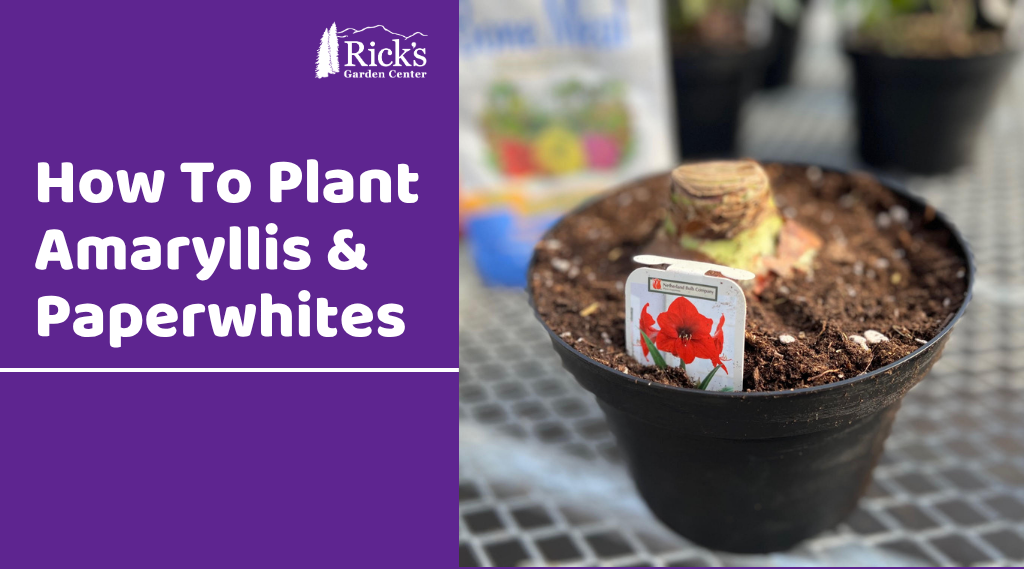
How To Plant Amaryllis & Paperwhites
Our holiday bulbs are here! Make way for Amaryllis & Paperwhites! Because these plants need to be planted about eight to ten weeks in advance, to flower around Christmas, we thought we’d provide this care guide now. Caring for and planting these bulbs is surprisingly easy!
How To Plant Holiday Bulbs
Ingredients:
-Bulbs, one Amaryllis or ten to eight Paperwhites.
-Well-draining soil (we’re using Fertilome Ultimate Potting Soil).
-8 Inch Container.
-Bulb fertilizer (we’re using both blood meal and bone meal).
Step-By-Step Guide
1.) Let’s start with the substrate. To prevent rot, pick soil with excellent drainage for these bulbs. We prefer Fertilome Ultimate Potting Soil, but Fox Farm’s Happy Frog works too. Gardners occasionally plant Amaryllis in a succulent mix, replicating their natural arid environment. Be cautious with this approach because it requires more watering due to extremely well draining soil.
2.) Once your soil is selected, fill about two-thirds of the container of your choice. Here, for both paperwhites and amaryllis, we’re using an 8 inch nursery injection pot. But you can use any kind of container. Having a hole for drainage is essential, and bulbs need some wiggle room.
3.) We advise fertilizing bulbs with a slow-release organic fertilizer. Whilst bulb-specific fertilizer, like Espoma Bulb-Tone, is ideal due to phosphorus levels, a flower fertilizer likewise works. Here, we choose to use blood meal and bone meal, high sources of nitrogen and phosphorus. We’ll eyeball the amounts because with them organic and a slow-release fertilizer burn isn’t a high concern.
4.) Plant your bulbs! Make sure roots are pointing down to the bottom of the pot, tip pointing to the sky. In fact, about one-third of the top of the plant should be above the soil. Amaryllis should have an inch and a half of space around the bulb and enough depth to properly root out. Paperwhites can be planted close together, but bulbs shouldn’t be touching. Think of how an egg carton is arranged! They should also have good depth for their roots to grow.
5.) Now, give the bulbs a light water. This helps pack them in. Rot is the primary cause of death for bulbs, so maintaining a good watering schedule is essential for their survival. We recommend watering every other day in a dry environment, less so in a humid environment. Lower watering to once every four days once green sprouts appear.
Getting Home & Garden Ready For Sale
Despite mortgage interest rates continuing to climb in the past several months, in this military base-saturated city, we continue to have a thriving real estate market. If you are prepping a house for sale, know that it does not have to be scary! Historically most house sales occur in the spring, so the later winter months are the perfect time to begin thinking about how to improve your curb appeal and get a “to-do” list fleshed out in time for your spring sale. Sprucing up your yard is especially important.
The first thing you should do is take your blinders off. You probably have lived at your house for some time. Pretend you are pulling up to the house for the first time or walk by your house like you are new to the neighborhood. Take notes. Like an artist, you will come back to this step multiple times, building a masterpiece!
- Do you have a couple of ways your eye can “travel” through the landscape? If not, how can you add interest in multiple areas of your yard?
- What are the immediate eye sores? Clean those up or remove them immediately.
- What is the highlight of your home and yard? How can you further accent it?
- What trees or shrubs need to be trimmed?
- Are there holes in the landscape? Can a tree, shrub, ornamental grasses, several perennials, or a boulder fill in the gaps?
The second thing that is helpful to do right now is a general yard cleanup. Even if your yard is ho-hum, an easy way to elevate the place is to do some general yard maintenance.
- Clean pathways/ sidewalks by sweeping dirt/ debris or pulling weeds
- Rake leaves off your lawn. Leaves can be mulched into your lawn also, by running a lawn mower over them.
- Remove any weeds. Pulling is preferred especially now, when they are most likely dead. Feel free to put a natural pre-emergent down, like corn gluten. This will prevent weed seeds from germinating in the spring.
- Pruning should be done in the spring, but take note of which trees or shrubs should be addressed before your sale.
- Consider if outdoor statement containers should be purchased, so you can plant vibrant flowers ahead of putting your home on the market.
- Add a fresh layer of mulch or gravel to refresh any landscaping areas. Do not forget to put a weed pre-emergent down under the mulch and on top of the new mulch, to discourage weed growth. There is nothing more aggravating than completing a clean landscaping job to have weeds pop up in the spring. You can also consider laying down weed barrier fabric under the mulch.
- It should also be mentioned that you should remove any yard art that is specific to your “aesthetic.” You want potential buyers to imagine their own lives when doing a home walkthrough. Pack the garden gnomes away for when you move into your new place!
Next, you will want to address outdoor lighting. If you plan on selling in the spring, you will be hitting the market before it is light in the evenings. You will want to ensure that you make your house feel welcoming as people come to showings after getting off of work.
- Highlight your entrance. This is the most important area to highlight. If you are concerned about light pollution, make sure the light casts downward, instead of out or upward. If you are further interested in reducing light pollution at your home, check out this resource on what light fixtures are best: Click here!
- Other areas to consider lighting include pathways, the address number on your house, and any architecture or plants you want to illuminate.

Finally, consider your plant life. You will not do any planting until spring, but this is a wonderful time to find plants that will fit your needs. In the first step, you identified if your eye traveled through the house/garden lay out, if there were any highlights, and if there were holes in the landscape. As you choose plants to fit these roles, consider the following:
- How much water does it require? Will you be able to ensure it gets the water it needs until you sell? Will potential buyers be turned off by the amount of water that you use? Consider more xeric or water-wise options, if this is the case.
- How much maintenance will it require? For example, many younger buyers are no longer interested in lawns, due to the regular, watering, fertilization, aeration, and mowing that a lawn requires.
- If you have deer or rabbits in the neighborhood, consider choosing species that are resistant to their munching, so all of your plants look good for your closing!
- Resources that are helpful when selecting native plants or water-wise plants are detailed below:
- Plant Select is a brand of plants that we sell. They have an excellent variety of plants and detailed descriptions of each plant. They specialize in plants that are, “…unique, smart, and sustainable plants inspired by the Rocky Mountain region.” Check them out here: Click here!
- High Country Gardens is another gem of information. They “…offer a diverse and ever-expanding selection of plants for the unique challenges of Western gardens.” Use their perennial filter to drill down to find those difficult-to-find plants that are deer-resistant, in partial shade, water-wise, and good for your zone. Check them out here: Click here!
- Finally, a local resource. Please check out the water-wise demonstration gardens that the Colorado Springs Utilities have. They have two different locations listed below. All of the plants are labeled, which is helpful when you find a plant you have fallen in love with! It is helpful to go visit through the four seasons, so you see how foliage and plants change throughout the year. Check them out here: Click here!
There you have it! Good luck with getting your property ready for sale!

Tool Care Guide
Fall is here! This is a bittersweet moment for me. Harvest has hit its finale, and I am beginning to accumulate a stack of books that will keep me growing while my garden begins to take a snooze. Before I cozy up on the couch, and have a cup of tea- I always take care of my end-of-season garden tool maintenance. Garden tools should have regular TLC, especially after use, but in reality, this may not happen. I will detail daily care at the end of this article for your convenience.
End-of-Season Garden Tool Maintenance:
Deep Clean and Oil Pruners:
This is imperative to reduce disease and rust on your snippers, prolonging their use.
- Pruners should be taken apart and deep cleaned at least once each season.
- Unscrew any nuts/ bolts that hold the pruners together.
- Wash all parts separately in soapy water.
- Soak all parts in vinegar, then rinse with water.
- Rub with steel wool to remove any rust, then rinse and dry.
- Soak in diluted bleach water to sanitize, then rinse and dry.
- Buff with linseed oil and reassemble.
Sharpening:
Both pruners and Hori knives, as well as long-handled tools (hoes and shovels), need to be sharpened every season. Keeping pruners sharp helps produce clean cuts on plants, reducing the entry of any disease. Other tools benefit from a sharpening, making your life much easier. Digging a hole to plant with a dull shovel is no fun!
- Anything you are going to sharpen should be cleaned first. Long-handled tools may not need the vinegar/ bleach/ oil treatment unless there are concerns about rust.
- Push the sharpening file in the same direction across the blade and follow the original blade angle. Do not rub the file or stone back and forth, this does not sharpen but dulls the blade further.
- Smooth these newly filed edges with a sharpening stone.
- We recommend wearing eye protection and gloves when sharpening to protect against metal slivers.
Care for Wood Handles:
With long-handled tools, it is important to take care of wood handles. Utilize durable tape (think athletic tape or other heavy-duty tape) for minor cracks. Anything that is more compromised should be replaced immediately to prevent injury.
- Wipe down the handles with a damp cloth.
- Inspect for cracks or any weak spots between the handle and the tool head. Address with durable tape or replace the wooden handle if damaged.
- If needed, lightly sand the handle to smooth splinters, and rub linseed oil to condition.
Daily Garden Tool Care (when you have time!):
Generalized care:
- Rinse any digging tools, then use a wire brush or something similar to get rid of any stuck dirt or debris.
- Scrub snippers down with a brush and soapy water.
- If any tools were used with diseased plants or infected soil, make sure you disinfect them before any other use. Soak the infected tools in a diluted solution of 2 cups of bleach mixed with 1 gallon of water. Then rinse in plain water, and follow with a generous wipe of rubbing alcohol.
- Before storing tools, rub them dry with a rag.
- To help prevent rust on digging tools, mix a bucket of sand with plant-based oil, like linseed oil (avoid any petroleum oils, as this reduces plant vitality). The sand should be damp with oil, but not wet. Plunge any blades, tines, or teeth into the sand a few times for a quick clean, or do this following regular maintenance once the tools have been wiped dry.
- Store your tools in a dry and well-ventilated place. Small hand tools can be stored directly in a dry bucket of sand or gravel, and larger tools should be hung so as not to dull their blades in a mad scramble.
Removing Sap:
- Wipe blades with a rag dipped in mineral spirits or turpentine.
- Submerge and clean the blades in soapy water. Rinse and then wipe with linseed oil.
Preventing and Removing Rust:
- Soak any tools showing signs of rust in a 50/50 mixture of vinegar and water overnight.
- Scrub the affected areas with steel wool.
- First, wash in soapy water, and then rinse.
- Rub dry and then buff with linseed or a mineral oil.
All tool maintenance requires is a little elbow grease and time. Sometimes we neglect our tools throughout the season, but I can tell you the reward of pulling out a clean, sharp, and shiny tool in the spring never ceases to make me smile. Happy fall, everyone!
New School Fall Gardening Stretegies
By Katherine Placzek
With fall approaching, many of you are getting ready to put your garden beds and other portions of the landscape to bed. With a more eco-friendly mindset, we would like to suggest a couple of tweaks to your typical routine.
Old school: Raking and bagging leaves, tossing them out for the trash.
New school: Rake leaves from below trees, and use them as mulch around your perennials, shrubs, or on top of your vegetable garden beds. You can also run these over with a lawn mower to mulch them into your grass.
Why: Organic matter, including yard waste, is the most prolific item in United States landfills. Consequently, this unsustainable practice directly contributes to greenhouse gas emissions. Conversely, organic material returned to the soil reduces your environmental impact while providing a useful garden resource. These local sources of organic material and nutrition (from your own yard’s leaves) will feed and insulate your yard all winter long! Decomposing leaf matter enriches the soil, adding carbon and nitrogen to the soil, while plants “sleep.” Leaves also create safe places for native bees and other pollinators. Did you know that almost three-fourths of Colorado’s native bees nest and overwinter underground? Tip: Deeply water the leaf litter in after it has been placed. This creates a wet decomposing mat that will not blow away as easily.
If you have excess leaves that you are not going to be using, please feel free to bring your bagged leaves by our nursery gate (located at 600 N. 18th St. Colorado Springs, CO 80904). This is a community pile that other members come to gather for their own gardening usage.
Old School: Trim any perennials and remove them before the first snow.
New School: Leave all of your woody stalks, leaf matter, and ornamental grasses all winter long!
Why: This allows for winter interest and provides shelter for any hibernating insects. This is especially true for native plants that act as habitat for many native and beneficial insects. Larger life forms, including birds and mammals, will also benefit from grass seed heads left standing, and other plants that provide shelter in the harshest months. If this is unsightly for you, trim your plants, but leave the stems and other leaf matter on the ground to help create shelter throughout the winter. When soil temperature has reached 50 degrees Fahrenheit it’s the preferred time to begin trimming these perennials in the spring, after many insects have completed their wintering cycle.
Old School: Let the winter snows water your outdoor plants.
New School: Water trees, shrubs, and perennials on nice days throughout the winter.
Why: Unfortunately Colorado Springs does not get enough reliable winter moisture to overwinter many plants. This is especially true for newer plants that do not have an established root system yet. Many trees and shrubs, even those that are well-established, should continue to be watered on warm winter days from October through March. When it gets up to 40 degrees Fahrenheit, pull out a hose or dust off your watering can and soak up some of those winter rays, yourself, while you water. Make sure you unhook any hoses after use, as temperatures can cause freezing in the hose bib and other hardware.
Old School: Say goodbye to gardening until spring.
New School: Fall and winter sow, including vegetable and perennial flower seeds.
Why: Many annual vegetables and perennial flowers have a natural cycle where they drop seeds or fruit in the fall. Mimic nature and plant some of your own seeds in the fall to see what comes up earlier and hardier in the spring! In the vegetable garden, this especially works for cold hardy greens. Think spinach, lettuce, arugula, radicchio, etc. For perennial flowers, like wildflowers, it is recommended to put these seeds down in the fall, as many of our native flowers require a cold stratification period. While many people may set up sections in their freezer and fridge for cold stratification processes, direct seeding in the fall eliminates the juggling of space in your fridge/ freezer. Let the ice cream stay where it is!
Old School: Wait until spring to amend any of your garden beds.
New School: Amend your garden beds in the fall so you can plant right away in the spring.
Why: Fall is a good time to test your soil so you know how to amend your beds. Our soils typically fall in the basic pH range here in the greater Colorado Springs area. This can impact how readily available nutrients are to our plants. Do your research and get your soil properly in shape for your spring! Remember that you can also amend with what nature provides; leaves, manure, compost, and other organic matter. These sources do not have a precise N-P-K (macronutrients: nitrogen, phosphorus, potassium), nor spelled out micronutrients (calcium, magnesium, iron, etc) so it is recommended to test your soil in the spring again to see how your soil has changed due to any unregulated organic material. We offer pH and N-P-K, testing in-store, but the CSU extension office also offers a wide range of soil tests.
Now that you know these new school techniques, you might just try other new gardening techniques in the growing season. I know, I know- I am getting ahead of myself! Happy gardening!
Protecting Our Watershed While Gardening & Landscaping
By Katherine Placzek
Every item that we use in our green spaces– fertilizers, pesticides, sprays, powders and granules, etc. all make their way into the water, after it rains or when we water our plants. This means a myriad of compounds, organic and synthetic, are making their way in our or someone’s drinking water. Yes, most of our drinking water is filtered, but this also impacts lakes, streams, aquifers, wells, and other sources of water that can be a habitat for other living organisms, big and small. While this may feel overwhelming initially, we have the power to make little meaningful changes in the way we manage our landscapes.
Lawn and Garden Fertilization
Three things make a difference here. Quantity, quality and timing:
Quantity: When you use fertilizer, always use the instructed amount of fertilizer or a diluted/ lesser amount. This ensures that your plants can take up the applied fertilizer and that excess is not making its way into our waterways. Excess fertilization can stress plants and negatively impact water quality. Over fertilizer use through agriculture, golf course maintenance, and community landscaping have contributed to dead zones in waterways. A dead zone is where all aquatic life ceases to exist. First, expansive algae blooms occur that crowd out sunlight, which choke oxygen out of the environment, causing inhabitable levels for any life, plant or animal. While some dead zones do occur naturally, the second largest one in the world is in the Gulf of Mexico, where many of North America’s waterways meet. This dead zone is widely attributed to human causes.
Quality: When choosing a fertilizer, it is advisable to read the ingredients, similar to reading food labels. If you cannot recognize an ingredient, know it is likely synthetic. Not all things that are human made are bad, but do your research. You may decide that you do not want some of these ingredients in your garage, home, yard, and local ecosystem. This is why Rick’s is proud to continue to carry our Organic Lawn and Garden fertilizers. Both of these are gentle fertilizers, with low nitrogen levels, and contain ingredients such as chicken manure, bone meal and blood meal.
Timing: Never fertilize before a severe rainstorm where run-off can take the majority of your fertilizer downstream. This is also cost prohibitive. If you plan on putting fertilizer down before predicted moisture, consider prior to a snowfall, where the melting snow can bring the fertilizer into the ground gently. Also read the instructions. Many fertilizers recommend a fertilizing schedule. Follow this, or see if you can stretch the schedule out further, to reduce the amount of fertilizer that you have to buy and apply throughout the year. Never fertilize more than what is recommended, this can stress the plant, and excess product will be absorbed into the waterways.
Pesticide Use
Pesticides include insecticides, herbicides, and fungicides. Similar to fertilizing, follow the same wisdom regarding quantity, quality and timing. We have said it before, but just to remind you: “While pesticides are convenient and sometimes necessary especially when mitigating invasive plant species, pesticides negatively impact pollinator numbers…. It is important to remember that while applying control products at night can reduce pesticide exposure to several pollinators/ beneficial species, this does not protect nocturnal pollinators such as moths and bats. When we use pesticides there is no current method that does not negatively affect pollinators or their second tier predators, who are further up the food chain (Excerpt from our March 2024 newsletter).” All of these pesticides reach water sources that are drinking water for pollinators and larger organisms: birds, fish, fox, deer, etc. Many of the chemicals used in popular pesticides, including glyphosate do not break down with water. This means the problem is washed downstream, but never away, and can exist in our waterways indefinitely. Manual removal of weeds is no fun- we all know this. When we choose conventional pesticides, we give up clean water. Limiting the amount of pesticides we use in our yards is one step to keeping our watershed less polluted.
General Maintenance
When you mow your lawn, consider mulching the cut grass instead of bagging it unless you use the cut grass in your compost. Mulched grass that has been chopped by the mower multiple times and is spread evenly over the lawn acts as a wonderful additive of organic material to the soil. This method improves water retention, and overall soil health, decreasing your need for fertilizer. If you mulch the cut grass, but leave large clumps of thatch, this can burn your grass and be swept away into a waterway. This process can act similarly to over fertilization, causing algae blooms downstream. Use the same logic with fall leaves. Mulch leaf litter and either use it on your lawn or in your garden, to add nutrition to the soil. Avoid abandoning leaves in gutters, and storm drains, as it increases excess nitrogen in the watershed. In the winter, make sure you are using a low saline and non-toxic ice melt as well. Water guardianship takes place in all four seasons!
Plant Selection
Finally, the fun stuff! Select plants and grasses for your landscape that are resilient to the Rocky Mountain circumstances. When we do this, we automatically reduce the need for mowing, fertilizing and the use of pesticides. Native plants especially, have been living here in the Colorado landscape much longer than any human lifespan. They have been taking care of themselves without any of our human care measures, such as fertilization, and will continue to do so into the future. I believe that by choosing to plant native plants in a landscape, you are actually simplifying your overall workload in the yard. You will fertilize less, you will use pesticides less, and regarding grass, you will mow less. That means more money in your pocket and more sitting on the back porch, sipping on a cold beverage. Cheers!

ECO-BRAN BRAN FOR GRASSHOPPERS DIRECTIONS
DIRECTIONS PULLED FROM PEACOCK INDUSTRIES BOOKLET ON ECO-BRAN
WE CLAIM NO OWNERSHIP OF GUIDE