The Importance of Winter Watering
The Importance of Winter Watering
While your favorite ski resort may be open for business, snowfall in the mountains as well as the front range is down this year. Reports show that snowpack levels across the state are 47% of normal levels. The southern Colorado region has below-average snowpack for this point in the season. While snowfall has been variable and not consistent even as far back as the 1800’s, there are some trends that we need to consider as gardeners. While not very strong, there is a correlation that has become apparent for lower elevation areas in the state (and could be an indicator for us in future years). If the first snowfall is not until November or later, this correlates to a lesser snowfall total for the area as a whole. This concern aligns with recorded temperatures, indicating that our region is experiencing warmer and drier autumns. This is significant for our landscape plants: trees, shrubs, and perennials. To break it down further, without any supplemental water, our outdoor plants are going longer without moisture after the main growing season and receiving potentially less water even when they do finally get snow. Additional food for thought includes that every foot of snow is roughly one inch of rain.
This corresponds to what we hear and see from our customers who come in the spring to replace plants that have experienced “winter kill.” While the term winter kill is traditionally used to describe icy or extremely cold temperatures that cause plant death, customers are using this term to describe plant death in general over the winter season. The type of death these plants are experiencing is completely preventable. They are dying of dehydration. Dry soils do not insulate roots, and thus plants are more susceptible to freeze damage and the swings of freezing/ thawing that we experience in this region.
When we have mild months, like this past November or December, we need to be winter watering. Winter watering requires you to manually water after irrigation or sprinklers are turned off prior to a freeze. Manually watering sounds labor-intensive in our world of automation, but it is rather simple. Remember, dear reader, gardening is one of the last bastions of manual labor. Enjoy the little labor it takes to have beautiful plants! There is a reason the phrase, “labor of love,” exists after all. I digress. Take a garden hose, if you are up for connecting and disconnecting a hose to a spigot, and let the hose trickle at the base of your plant(s) for a little bit. If you have a mature tree, let it trickle for about an hour or two. Less for smaller or less mature plants. If you don’t want to deal with a hose, take a bucket of water and pour it at the base of the plant for a drink. If you want to water your tree properly, you are shooting for ten gallons of water per inch of the tree trunk’s diameter. Which may be even more work than just pulling out your garden hose, that may or may not be mangled under your lawn mower. Pouring buckets of water repeatedly in the same spot may also cause some erosion, so I prefer the slow trickle method. Do this at least once a month on warm days (above 40- 50 degrees Farenheit).
Some individuals look for quick fixes, so they do not have to manually water. I caution against these methods, even if we carry the implements at Rick’s. Tree donuts, water gators, or water bags that have been designed to slowly water trees should only be used during the growing season, and outside of freezing temperatures. If the tree donut freezes at the crown of the tree, this can also cause death. This invention does not mimic snow. Snow slowly melts without creating a solid barrier. A frozen tree donut of ice prevents the tree’s surface roots from “breathing” or completing their nutrient exchange and absorption. Do not look for a shortcut on winter watering.
While many people believe that plants go to sleep during the winter and therefore do not need any care, this is not the case. This would be like a human being in a coma, but never being given an IV. An IV is to ensure that they are receiving liquids and nutrients until they wake back up! Apply this metaphor to your landscape plants. When we do not have the winter moisture and fail to winterwater our landscape plants, they die a perfectly preventable death. Enjoy the sunshine that is common in a Colorado winter, and pull out that garden hose to give your tree a drink!
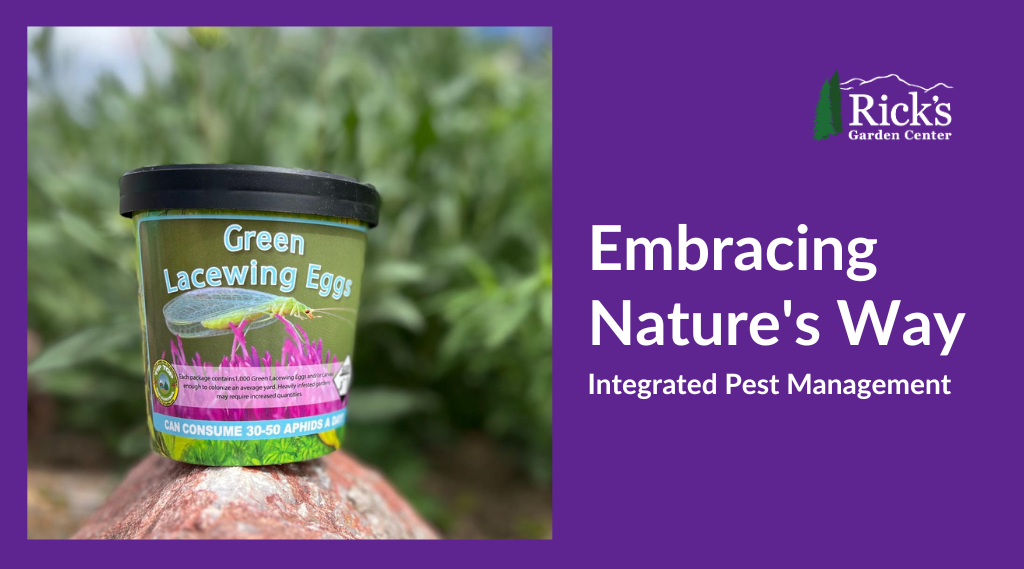
Embracing Nature’s Way: Integrated Pest Management
Integrated Pest Management is like the Gandalf of gardening – a wise, all-encompassing strategy that balances the forces of nature to keep your greenery flourishing. At its core, IPM is a holistic approach that combines biological, cultural, and physical/ mechanical control methods to manage pests and diseases. Instead of reaching for a pesticide or other control products, we tap into the power of Mother Nature herself to maintain a thriving and balanced ecosystem.
Some of our IPM practices include:
- Biological: Releasing ladybugs or other beneficial insects inside our greenhouses, or hoop houses to feast on those insects that are a bother; aphids, scale, mealy bugs, leafhoppers, etc. We also let spiders do their good work eating larger insects, like grasshoppers.
- Cultural: Reducing watering if fungal or pest problems crop up.
- Mechanical: Manually removing bugs from plants by hand or with water (aphids, mealy bugs, scale, potato bugs, etc)
While we lean into biological, cultural, or mechanical solutions, the last part of IPM is responsibly utilizing chemical products to rid of pests. This means we use more natural controls, such as Neem oil or Spinosad Soap, before other products. It is also important for us to factor in when pollinators or other beneficial insects may be around. So we try to spray when these individuals are not active. We also follow recommended application methods to avoid pollution of our environment or incur undue costs.
Why does Rick’s Garden Center Choose IPM Over Pesticides?
Environmental Harmony:
- Pesticides can disrupt your garden’s delicate ecosystem – effective, but with unintended consequences. IPM, on the other hand, dances with nature rather than against it. By embracing natural predators, beneficial insects, and environmentally friendly practices, we create a harmonious balance that keeps the pests at bay without harming the environment. By mostly avoiding synthetic chemicals, we reduce the environmental impact and create a garden that’s both beautiful and a haven for beneficial insects and wildlife.
Economic Sense:
- Let’s face it – pesticides can burn a hole in our pockets. IPM, however, is cost-effective in the long run. By relying on natural solutions, we reduce the need for constant reapplication of expensive chemicals, improving our bottom line.
Happy and Healthy Plants:
- Picture this: a garden where plants are not only surviving but thriving. That’s the magic of IPM. By addressing the root causes of pest problems and fostering a healthy soil environment, we ensure that your green companions are resilient and ready to face whatever life throws their way.
Community Connection:
- We believe in building a community that shares our love for the earth. By choosing IPM, we invite our customers to join us in creating a garden that is a testament to the power of working hand in hand with nature.
At Rick’s Garden Center, IPM isn’t just a gardening strategy – it’s a philosophy. It is about embracing the rhythms of nature and inviting others to join us toward a more sustainable future. So, next time you visit, know that you are not just buying plants; you are becoming a part of our eco-minded family.
Fall Perennial Planting
Planting in the fall can save you a lot of money while also giving plants a jump start next spring! Plants that establish strong roots during the fall will come back bigger and stronger in the spring time.
However, fall planting requires careful consideration and attention to detail from the gardener. The trick is to give fall plantings a little extra care to help them get established before the really cold weather sets in.
Here are four things you can do to help your plants get established:
Soil Inoculant
At the time of planting, be sure to use an inoculant specifically formulated for perennials, trees and shrubs. These products will help the plant to start establishing roots before all of the foliage dies back. We recommend using an inoculant over a root stimulator this late in the season so you can avoid giving any extra nitrogen to the plant before it goes in to dormancy.
Mulch
Mulch helps to retain soil moisture while also protecting roots from sudden changes in temperature. We recommend using 3″ of a good quality mulch to keep plants protected. Make sure that mulch does not contact the bark of woody perennials.
Protect Plants from Early Freezes
Keep an eye on the weather and cover the plants when the temperatures dip below freezing throughout September and October. This is most important for perennials. Trees do not need to be blanketed, but bark wrap should be used on all young trees to protect the trunks from splitting during our freezing and thawing cycles. When covering perennials, use heavy fabric or plastic and prop it up so that it is close to, but does not touch the plant (Plastic that touches the plant during a freeze can actually do more damage.) Be sure the covering goes all the way to the ground and cover the edges with soil or mulch so that it will trap heat from the soil.
Water
To support adequate root growth, plants will need to be watered regularly in the fall. Keep your soil evenly moist, but not soggy, through the fall time. Remember to monitor your plants regularly! A plant that crisps up due to lack of water in the fall time is not likely to survive the winter. When the plant goes dormant, they will require less frequent watering, but will also need to be watered throughout the winter. Remember that desiccation is the result of cold weather plus dry soil. For more details on winter watering, visit our Blog.