Guide To Hardening Off Tender Plants
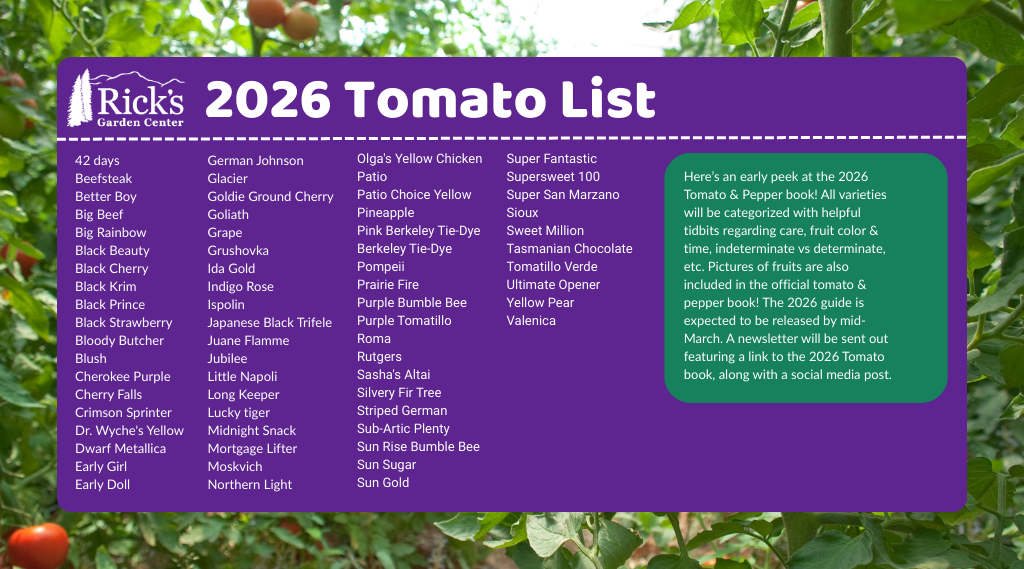
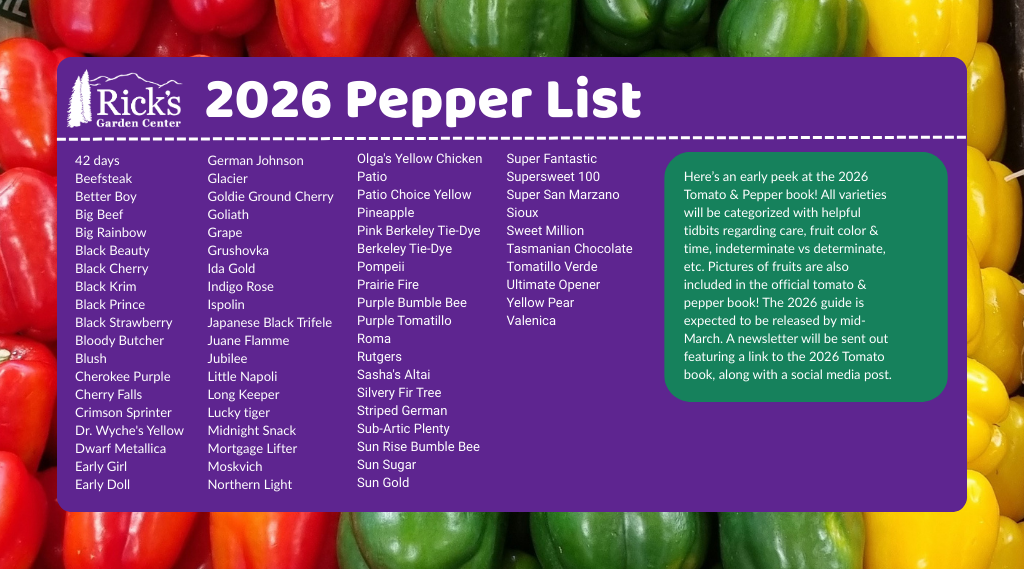
2026 Tomato & Pepper List
Colorado Seed Starting 101: Advice From Rick’s Grow Team
If you want lots of fruits and veggies come summer, the best gardening advice we can offer you is to start early and indoors. Colorado’s growing season is too short for many garden favorites. Eggplants, peppers and tomatoes do not have enough time exclusively outdoors to produce a bountiful harvest. That being said, we’d like to share some of our own techniques for extending the season. Starting seeds inside is the best way to get this jumpstart on the season. And I can thank our spectacular Grow Team, particularly Emma & Jenn, for the helpful advice! If you are a seasoned gardener, or this is your first season growing a garden, enjoy some of our best tips for being successful at seed starting.
Days To Maturity & Pre-Planting
As previously mentioned, Colorado’s growing season is short. When I visited Missouri one time, I was amazed that communities had tomatoes ready to harvest by June, and all of them were grown outside, from seed! Colorado gardeners can have full bushels of tomatoes come June also; we just have to start early and indoors. The best way to plan for this is to research days to maturity for each plant and start according to these specifications. Depending on when the plants reach maturity, you should sow seeds indoors an additional 4 to 6 weeks before the last frost date. For example, peppers need about 85 days to reach maturity. With a bit of math, 85 days turns into 12 weeks. Maturity refers to the number of days it takes the plant to produce fruit. Add four to six weeks on top of that for germination, then research your area’s last frost date through a trusted weather channel. Colorado Springs is typically on May 8th or even Mothers Day. Just to be safe, we’ll use Mother’s Day as a guide for our planning going forward. Subtracting roughly 14 weeks from May 10th means the optimal planting date is January 18th. A little late, but that doesn’t mean you can’t plant peppers; they’ll just fruit a little later! You can find maturity information on the back of seed packets. We’ll also provide a link below this paragraph to one of our favorite references, Colorado State Extension, and their incredible Colorado Vegetable Guide. Click here to read!
Drainage, Drainage, Drainage!
A major seed killer is overwatering, which is easy to do. However, raw seeds need to remain moist until cracking appears, which creates a conundrum in terms of watering. Both Jenn and Emma recommend a combination of fine-draining growing medium and special watering techniques to avoid this. In terms of growing medium, our Grow Team actually starts seeds in vermiculite. It has to be coarse for the best aeration, but if you water less, fine-grade is alright. Seedlings will stay in vermiculite for two weeks, then will be transplanted into a special seed soil or Foxfarm’s Happy Frog soil. Why do we not keep seeds in vermiculite permanently until they can go into larger pots? Vermiculite isn’t great at storing nutrients for seedlings, which obviously isn’t a benefit if you want to grow delicious, healthy, and strong vegetable plants (or any plant). And in terms of watering, we use misters, not watering cans or a hose. Keep the medium moist but not soggy. It’s the Goldilock’s ideal for the seeds!
Warm Bottoms, Cool Tops
A trick to creating a perfect environment for seeds, Emma told me, is to keep the following phrase in mind: warm bottom, cool tops. She and her grow team raise a majority of our vegetable starts in one of our many greenhouses, including a major crop of our tomato varieties. In the greenhouse, we have enough space to use heating mats, and regulate temperature with a greenhouse heater. We also understand many readers aren’t as lucky when it comes to such growing conditions. If you live in an apartment, a small home, or are on a budget, where do you even start, much less keep in mind the mantra “warm bottoms, cool tops?” Let’s translate the quote and make alterations. Seeds should have a warm and inviting substrate to thrive in, preferably one heated by a heating mat. Hence, the “warm bottoms” of the first half of the mantra. Whether growing in a greenhouse or at home, we always recommend a heating mat. It emulates summer growing temperatures that vegetables, like peppers, need. We carry various heat mats, some with timers and others without, that would work perfectly for a smaller grow setting. These mats should be set between 80 to 70 degrees Fahrenheit.
What about the meaning of “cool top?” In our greenhouse, there’s the heater, but even now, the environment is still considered “cool” compared to summer temperatures. The contrast between soil and air tells the seed which direction to grow, establish roots in the warm earth, whilst the stalk should reach to the cool air above ground. The air cannot be too frigid, however (hence the greenhouse heater), or else the sprout will have stunted growth or die. In a home operation, we recommend growing seeds in a warm spot with full sun, using a plastic greenhouse cover only when the sun moves away to keep in the heat. The space you plan to grow seeds in, shouldn’t go below 68 degrees Fahrenheit.
Light On The Subject
This is essential for growing seeds at home, Jenn mentions, “as much light as possible is essential for starting seeds.” And we’re not talking about keeping seeds by windows. We’re talking grow lights, which sounds like overkill to many, but if you want to avoid leggy plants they’re a must. Have you ever grown seeds at home and noticed that as they mature, they become long, stringy, and weak? This is what we mean by leggy. These plants are desperate for light, but without enough, they cease to function since photosynthesis depends on sunlight. Jenn recommends keeping the grow light as close as possible, and eventually “upgrading” seed domes (which is where the grow light can rest upon). This is the best way to avoid leggy seedlings.
Quick but helpful tips (we hope) to Colorado seed starting! We know gardening can be expensive, and some of these supplies will be, but in the end, nothing beats the pride of using your own plant starts for the summer. Plus, your wallet will thank you in the long run, too! Happy gardening!
On Crop Failure
By Emma Seibert
A few nursery Ricksters had been growing tomatoes in our greenhouses this winter as an experiment. In hopes of helping gardeners sample certain varieties before they commit to growing, nursery crew member Emma was dedicated to growing tomatoes and selling them as produce over the winter. Accidents happen to the best of us, however, including garden centers. Though crop failure is tragic, it’s not a sign to stop growing. Rickster Emma will talk you through her recent experience with crop failure…
A regular part of my job, especially in the summertime, is helping customers troubleshoot the issues they are seeing with their vegetable gardens and flower beds. Sometimes customers come in and I am able to recommend different caregiving techniques that can help bring their plants back to full health. Other times, I have the unfortunate job of bearing the news that the plant in question is either beyond saving, or even more heart wrenching, that it is dead. And that is what I wanted to talk about today. Dead plants are a rather sensitive topic for most growing enthusiasts; whether you’re a farmer and the health of your crop determines your livelihood or you’re just beginning your houseplant collection, crop failure is painful.
On August 26th, 2024, I seeded 32 tomatoes to plant them in large farm troughs in one of our greenhouses, with the intention of sharing the organic, local greenhouse-grown fruit with you all during the cold winter months. We wanted to provide our community with locally grown, ‘out of season’ produce that was flavorful and that you all could feel good about purchasing, knowing exactly where it was grown.
On January 13th, 2025, the tomato plants were nearly touching the roof of the greenhouse. They were blossoming and nearly every plant was fruiting. The green globes that hung from the tender stems had a yellow hue, indicating that ripening was mere days away. The stripes on the Purple Bumblebee tomatoes were starting to darken and the folds in the skin on the Sub-Arctic Plenty were beginning to smooth out, firming up the skin and giving it a glossy appearance. The first harvest date was so close I could nearly taste the tang of the Sweetie cherry tomatoes.
Then that same evening, the heater in the greenhouse wouldn’t turn on, despite the thermostat readings dropping. For some reason the thermostat and the unit heater were not communicating, but we couldn’t figure out why. As I got in my car to go home that night, I tried to remain hopeful that something would kick on, that someone would be able to figure out what was wrong in the next 20 minutes before the store closed for the night; all while watching the temperature readings in my car drop below 32 degrees.
The morning of January 14th, I hustled to the greenhouse as quickly as I could. Before I could even open the door, I knew it was done. There was frost coating the inside of the greenhouse walls; it had gotten cold enough inside for the condensation from the previous day’s healthy plant transpiration to freeze, indicating to me that every tomato plant inside must be frozen too. I went inside anyway and saw what I already knew to be true; every beautiful plant was frozen in time. The leaves were slightly wilted but maintained their vibrant green color, iced over in the moment of their last breath. It turns out that the safety fuse in the greenhouse heater blew out the previous day, preventing the heater from turning on despite the thermostat telling it to do so. We were unable to replace it in time for that night’s low of 10 degrees. As the daytime temperatures rose, the cell walls thawed and tomato plants flopped in defeat, their fruit turning to mush in my hands.
I cried, really hard. For a long time. I am not telling you this story to make you sad or say woe is me and my little crop of tomatoes. I am telling you to try to be of comfort; crop failure happens and hurts at every stage. I am telling you because I want you to know that yes, crop failure is a fact of life in the horticulture world. And also, the pain associated with such loss is a fact of that life too. So if you come in to show me your plant that is struggling and I tell you that it is dead, know that I understand that pain too. And I will do my best to help you pivot your crop, like I did with mine.
After the sore task of digging up all of the spent tomato plants, I went back and seeded some other, more cold-tolerant crops. And soon, the greenhouse will be a miniature forest again, but this time of kale and spinach, lettuce, and Swiss chard. I am not perfect, and neither are you, and neither is anyone no matter the extent of their experience. We all have to pivot sometimes and just know that the pivot can be the seed for new success.
The Gothic Vegetable Garden
By Katherine Placzek
Black & purple vegetables are not only for someone who is looking for a fun or Gothic vibe in their garden. Purple-ish fruits and vegetables have higher antioxidants, which play an important role in protecting your cells against heart disease, cancer, and other diseases. So it is healthy for you to plant and eat these dark maroon beauties!
All of these vegetables are carried by us as seeds through the Botanical Interests or Lake Valley Seed brands (both CO businesses). There is a wide array of purple/ black vegetables so feel free to go down the rabbit hole and create the dark and mysterious garden of your dreams! Note that various seeds may be out of stock throughout the season.
Amaranth
Burgundy: These plants offer beauty and sustenance! The plants can get tall and have elegant and eye-catching burgundy plumes that can be used in flower arrangements. The seeds were a major crop of the Aztecs, and are very high in protein and other nutrients. Cook the beige seeds like rice. Young leaves are also edible- use them in salads or steamed. The birds will also enjoy the seeds!
Basil
Cardinal: Cardinal’s’ deep crimson blooms allow this basil variety to be utilized beyond its culinary qualities! Use it as a surprising accent in a mixed container, or use it as a cut flower! The fragrance is lovely. With its strong scent, a little goes a long way in the kitchen. A wonderful dual-purpose herb.
Purple Petra: A deep purple, this basil adds vibrant color to any dish! A more mild basil- great for those who just want the essence of basil in their cooking. ‘Purple Petra’ can be used to make an elegant pink-tinted vinegar also! Use it as a companion plant to your nightshade veggies or as a statement plant in an herbal ensemble or annual flower container.
Purple Opal: Opal Basil has eye-catching purple leaves, and will bloom during the summer with light pink flowers. Feel free to fall in love with this variety! Grow it just for its rich beauty or for its culinary uses. Highly flavorful, this basil variety has flavor notes of cinnamon, anise, mint, and clove!
Siam Queen Thai: This beautiful basil has a complex sweet and spicy flavor with a hint of anise. Broadly used in Thai and Vietnamese dishes- it is versatile! It is easy to grow and highly ornamental with its dark amethyst blooms. Flower farms also grow Thai basil, for cut bouquets. Include it in your garden flower bunch and enjoy the unique fragrance. Bees also love this stuff!
Sweet Thai: Thai basil is of course a popular herb in many Southeast Asian cuisines, and is most regularly highlighted in a warm bowl of Vietnamese pho. This variety holds its flavor and texture through cooking more than other basils. Lovely in salads or when eaten fresh. Sweet Thai’s dark purple flowers and intoxicating scent allow it to double as an excellent addition to the flower garden. Produces well in containers also.
Beans
Royal Burgundy (Bush): Royal Burgundy has yummy purple pods that are easy to spot among green leaves. A wonderful variety to grow in cool weather and is unlikely to be challenged by bean beetles. A good container variety, as well as disease-resistant.
Trionfo Violetto (Pole): Trionfo Violetto’ translates to “purple triumph.” This Italian heirloom will win your heart, with its crisp and flavorful purple pods. While highly ornamental the plants are also highly prolific! The plants climb 6’–8′, and have prolific light amethyst flowers that bloom against green leaves that sport purple veins and stems. Similar to other purple beans, the pods magically turn green when they are cooked!
Beets
Bulls Blood: Plant one row of this beet variety for the beautiful greens, and another for the flavorful roots! ‘Bull’s Blood’ is valued for its tender, sweet, and deep red– almost plum foliage. Originally selected from a French heirloom for the darkest colored leaves, the 16″ “greens” are rich in nutrients! The roots are delicious as well, especially so, when harvested small. Use in succession planting as multiple crops are possible throughout a season.
Broccoli
Burgundy: This variety of broccoli is considered a “sprouting broccoli” since it produces one small main head, but then produces generous side shoots. Purple broccolis tend to be tender, flavorful, and full of antioxidants! ‘Burgundy’; is tolerant of a wider range of temperatures, which allows a longer harvest period. Some gardeners prefer to pinch the main floret off early on, to encourage more abundant side shoots. Also resistant to the disease, Fusarium yellows.
Cabbage
Red Acre: Jazz up cole slaw or any stir-fry with this gorgeous, deep-fuchsia cabbage! This variety has a very fresh and sweet flavor. Solid heads form early and grow on compact plants making ‘Red Acre’ an ideal choice for urban gardeners who may have limited space. Resistant to splitting as well as cabbage yellows disease. The heads store very well, in the refrigerator or a root cellar. A variety you must try!
Carrots
Cosmic Purple Carrots: While various colored carrots seem to be the new fad, they have been around for centuries. In fact, the purple carrot has been around for at least 1,000 years! While previously unpopular compared to orange carrots, purple carrots have been rediscovered, and rightfully so! Besides being high in vitamin A, purple carrots contain anthocyanins (an antioxidant) that are common in blueberries. Kids will love them!
Eggplants
Black Beauty: A beautiful nearly black vegetable with lovely, lavender blossoms pretty enough to grow in the flower garden! ‘Black Beauty’ has set the standard since 1902 for large and high-quality fruit. When harvested at its peak, the skin is tender, so no need to peel it; making it perfect for eggplant parmesan, ratatouille, and grilling!
Finger Fruit Purple: Grow fast-producing clusters of beautiful eggplants on your patio or a sunny corner of your vegetable plot! These 4-6″ fruits contain few seeds and have thin, tender skin—perfect for stir-fries and roasting. A plethora of royal purple fruits on just 22-38″ tall plants make this variety a perfect fit for containers and small gardens.
Jewel Amethyst: ‘Jewel Amethyst’ is perfect for containers, since it has a tidy habit. You will also notice its growing pattern makes harvesting a joy! The oval, purple fruits are best harvested when about 3”–4 ½” long, to stay tender. Harvest regularly from this variety to keep eggplant producing throughout the season.
Long Purple: This long, slender variety, is not usually found in grocery stores, and is a treat! Sometimes called ‘Italian Long Purple’, this prolific heirloom will bring beautiful ruby-purple color to the garden and savory goodness to the table. Enjoy in a wide variety of dishes!
Kohlrabi
Early Purple Vienna: Early Purple Vienna kohlrabi is an easy-to-grow cool weather crop that forms a distinctive dusty lilac bulb with pale flesh above ground. A beautiful plant! Peel its crunchy bulb and enjoy it raw or cooked. Leaves are also edible- eat similarly to collards, or other steamed greens. Kohlrabi is high in fiber, making it an excellent veggie for overall gut health. Kohlrabi is also high in isothiocyanates and glucosinolates, which are powerful antioxidants, thought to lower the risk of certain cancers, heart disease, and inflammation. Keeps well in the fridge.
Lettuces/ Greens
Brentwood Lettuce: This variety produces pretty burgundy lettuce leaves making for some beautiful salads! The heads produce high yields in compact spaces, and their bolt resistance allows for a long harvest. Also resistant to downy mildew, lettuce leaf aphid, and Fusarium wilt.
Dazzling Blue Kale: You will be mesmerized by the beautiful colors of this extra-cold-hardy kale. It is even more cold-tolerant than other lacinato types. The purple midrib pops against the blue-green leaves, some of which may take on more purple hues in the cool temperatures of fall. Lacinato kale is ideal for kale salads. Pick tender, baby greens for fresh salads, chips, or sauteing, in just 30 days!
Marvel of Four Seasons: Tasty and attractive, this 1800s French heirloom is also known as Merveille de Quatre Saisons. The variety has sweet and tender leaves that are chartreuse green at the base, turning to a beautiful cranberry-red, and forming a crinkly rosette! Gorgeous! Rosettes are 8″–12″ in diameter and good for large containers.
Red Russian Kale: Typically, kale gets sweeter after the first fall frost. ‘Red Russian’, on the other hand, is sweet and tender all the time. The lavender veins are part of what makes ‘Red Russian’ as attractive as it is delicious. Harvest baby greens in just 21 days!
Truchas Mini Romaine: This deep-merlot, mini-romaine is a game-changer for salads! ‘Truchas’ is compact and easy to grow in small spaces. It also creates gorgeous contrasts with green lettuce. Uniform leaves stay upright in the garden and make for easy plant cleanup. Has disease resistance to downy mildew, lettuce die-back, and lettuce mosaic virus.
Nasturtium
Black Velvet: These edible beauties add glamorous, ruby-black color to your salads and cheese plates! All parts of the flower (leaves, seeds, stems and flowers) are edible! Garnish tacos, avocado toasts, and pasta dishes with these beauties! Excellent as a companion plant to your tomatoes, and they repel several pests. Gorgeous in containers as well.
Tom Thumb Black Velvet: Tom Thumb features velvety, nearly black flowers with contrasting bright green foliage! Compact plants make this an outstanding choice for the border and containers. All parts of the flower (Leaves, seeds, stems and flowers) are edible! Add flowers to charcuterie boards, gazpachos, strewn on roasted root veggies, or create vinegar from them, for various culinary experiences!
Okra
Red Burgundy: Whether you eat okra or not, this plant is worth growing, just for the beauty of it! The pods are deep crimson edging toward maroon and are preceded by gorgeous yellow flowers that the bees love. This is the most productive red variety and will produce tender, 6″-long pods that are delicious in soup, gumbo, and stew, or deep-fried.
Shiso
Green and Red Shiso Perilla: An absolute must for herb gardens! Also called Japanese basil or the beefsteak plant, shiso’s incredible flavor can be described as a combination of cinnamon, mint, and clove with notes of cumin. A beautiful, heat- and drought-tolerant bedding plant that attracts pollinators, and is excellent for containers. This packet provides 75% green shiso and 25% red (shows up as a deep mulberry color).
Snap Pea
Sugar Magnolia: Wow, a purple snap pea that is tender and delicious! Enjoy the pretty purple blooms first, then the purple pea pods. Eat them without shelling, dipped in hummus, in a salad, or in stir-fries! Long hypertendrils (vigorous, multi-branching tendrils) support the 6′-7′ vining plants. This growing pattern creates an airy structure that helps prevent mildew. Some of these open-pollinated peas may be flecked with green, or be fully green.
Tomatillo
Purple: A purple tomatillo! Not only delicious but alluring also. The purple fruits are much sweeter than the green types and rich in antioxidants. Let the fruit remain on the plant as long as possible until the papery husks split for the best flavor and color. Tomatillos grow best in conditions similar to tomatoes (because they are related) but will handle a lot more heat. Tomatillos require cross-pollination so plant at least two plants in your garden to ensure good fruit production
Tomatoes
Black Krim: This Russian pole heirloom originated in Krymsk on the Black Sea in Russia. Baseball-sized fruits weigh 10–12 ounces and have dark reddish-brown flesh filled with a rich, slightly savory flavor. Fruit sets well in heat and is a reliable “black” tomato, producing even under adverse conditions from summer to fall. Make sure to stake or cage, as the plants can reach 6′ or more!
Cherokee Purple: Cherokee Purple’ is said to have been given to a Tennessee family by the Cherokees over 100 years ago. This dark maroon tomato has just the right balance of sweetness and even a hint of smoke, making it a winner in taste competitions. From summer into fall, you will harvest lots of 10–12 oz. tomatoes from this well-regarded heirloom variety. Make sure to stake or cage, as the plants can reach 6′ or more!
Chocolate Cherry: Chocolate Cherry tomatoes—Yum! These 1″ purplish-red, delicious tomatoes are great for snacking on and add a bit of sweetness to salads and pasta. The prolific vines bear seemingly endless trusses with 6–8 ounce fruits that will bring you back for harvest after harvest. Fruit is crack-resistant! Make sure to stake or cage.
Watermelon
Sugar Baby: The taste of summer? Watermelon! As the name suggests, ‘Sugar Baby’ is sweet, sweet, sweet! It is also small enough to easily fit in the refrigerator. This plant produces a bountiful crop of 8–10 pound deep dark emerald green orbs that have juicy red flesh.
Zucchini
Black Beauty: Black Beauty is an early maturing zucchini-type squash that features delicious deep black to green fruits with pale flesh. A very easy-to-grow bush variety that is highly productive all summer long. Enjoy grilled, sauteed, fresh, in soups, or zucchini bread!